FORTHCOMING · HISTORICAL NONFICTION & FAMILY HISTORY
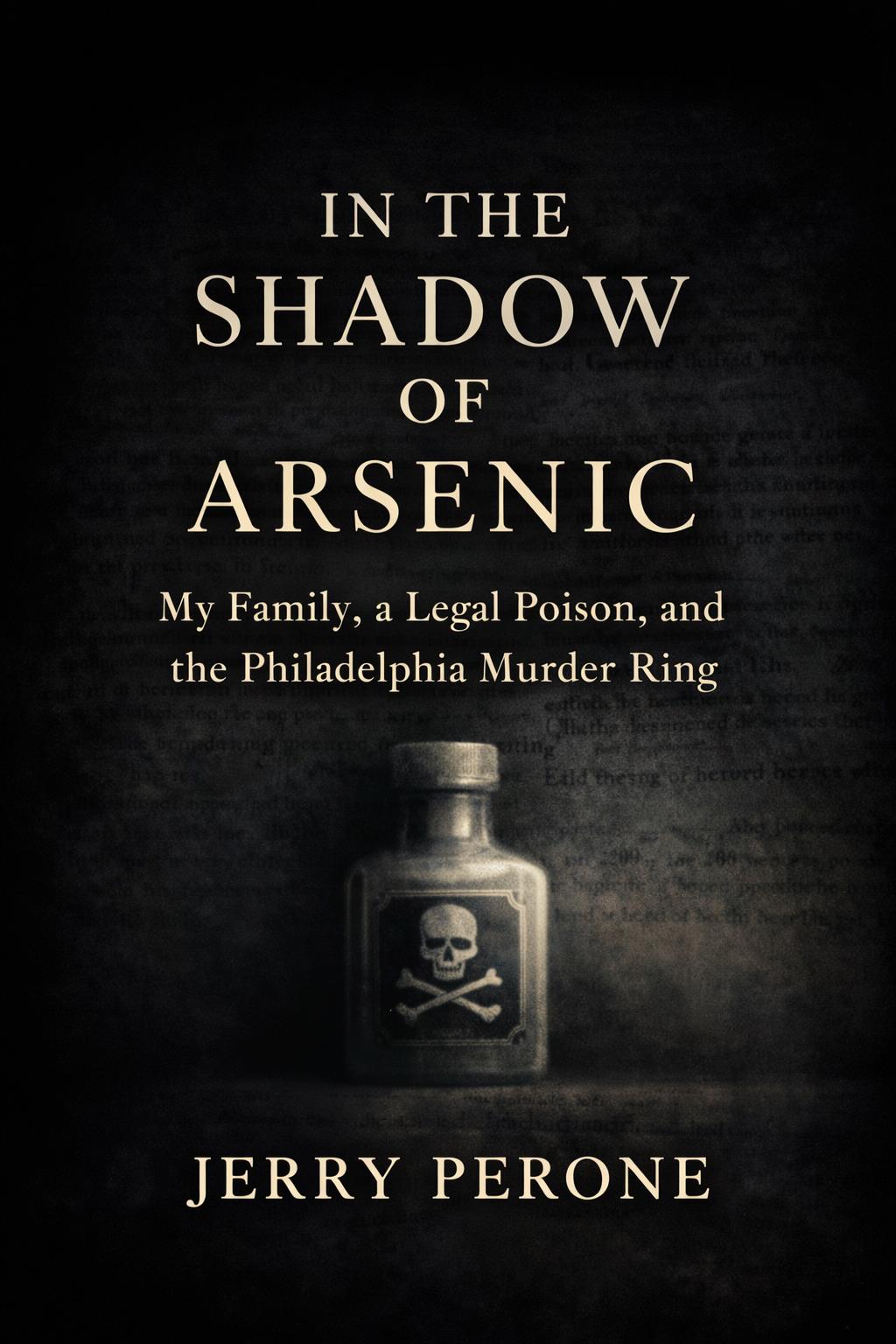
In the Shadow
of Arsenic
My Family, a Legal Poison, and the Philadelphia Murder Ring
By Jerry Perone
A family history reaching into one of Philadelphia’s darkest chapters—and the lives of the children left behind.
Publication details to come.
WHY THIS STORY IS PERSONAL
My mother’s family.
My reason for telling it.
My connection to this story begins with my mother, Theresa Lisi Perone. She was the oldest of three children, with a younger sister, Marion, and a younger brother, Girard.
Their mother—my maternal grandmother, Rosa Martino—died during childbirth in 1931. Their father, my grandfather Próspero Antonio Lisi, remarried in February 1933. His second wife was Rose Carina.
By June of that year, he was dead. He had died of arsenic poisoning at the hands of his second wife. Within two years, my mother and her siblings had lost both parents.
For me, the Philadelphia arsenic ring is part of my family’s history. One of its victims was my grandfather. One of the children left behind was my mother.
In the Shadow of Arsenic is historical nonfiction rooted in that connection. It tells a story of crime and family, and of the world in which those lives intersected.
HISTORICAL BACKGROUND · FURTHER READING
The history behind the story
The Philadelphia arsenic ring forms the historical backdrop to In the Shadow of Arsenic. This journal article offers a broader account of the crimes, the investigation and the court cases surrounding that history.
Arsenic and No Lace: The Bizarre Tale of a Philadelphia Murder Ring
Young traces how investigators connected suspicious deaths to life-insurance schemes and followed the evidence through arrests and trials. His account includes Rose Carina and other figures connected to the ring.
Presented here as background reading alongside Jerry’s family account and book in progress. This is a historical article by Robert James Young, Jr., separate from Jerry’s own writing.
Complete original scan with source notes · 18 pages · 1.2 MB. View the bibliographic record.
FROM THE BOOK IN PROGRESS
Why Here? and Why Now?
The arsenic murders that surfaced in South Philadelphia and South Jersey at the end of the 1930s did not emerge from nowhere. They grew out of a particular place, a particular people, and a particular set of pressures. The question is not simply why poison, or even why murder. The harder question is why this happened here - in the South Philadelphia-Camden-Hammonton corridor - and not in some other Italian stronghold such as New York or Chicago.
No single explanation is enough. The answer lies in a convergence of conditions: immigration patterns that created dense village-based communities; a corridor that tied city blocks to farm towns and mill districts; Depression-era hardship; a culture in which reputation and privacy carried enormous weight; the presence of insurance money and remarriage as practical facts of life; and a poison that could pass, for a time, as illness. This was not a world built for gunfire in alleys. It was a world in which a cup of coffee, a bowl of soup, or an evening meal could become the instrument of death.
South Philadelphia and South Jersey were not separate settings. They formed one social landscape. South Ninth Street and the Italian Market were its commercial heart. Camden supplied industrial wages. Hammonton and the farm towns of Atlantic County supplied land, produce, kinship, and continuity. Families moved among these places with ease. A man might work in Philadelphia, court a widow in South Jersey, buy from cousins at market, attend Mass with relatives across the river, and be buried in yet another town. Travel between these communities did not require leaving the world one knew. It meant remaining inside it.
That matters because the poison cases did not unfold inside a single neighborhood. They moved through a corridor. The same surnames, dialects, parishes, and family connections appeared again and again. News traveled quickly, but it did not always travel publicly. It moved by kinship. It moved through widows, grocers, priests, boarders, in-laws, and funeral gatherings. In such a society, everyone knew something, almost no one knew everything, and very few people wished to become the one who spoke first.
The Italian and Sicilian population in this region had not merely arrived; by the 1930s it had put down roots. Many families had come through chain migration, with one relative following another from the same province, the same village, even the same street in the old country. Philadelphia's Italian districts were never a single undifferentiated mass. They were a patchwork of loyalties shaped by dialect, birthplace, parish, and family reputation. Hammonton intensified that pattern. It had developed into a notably Sicilian settlement, one in which village ties could survive transplantation. A person was not just Italian. A person was from somewhere, related to someone, known by someone else.
That degree of social density produced security, but it also produced enclosure. Families helped one another survive. They found rooms, extended credit, arranged introductions, watched children, supplied work, and carried one another through illness and bereavement. The same closeness also made concealment easier. A woman who married again did not do so in anonymity. A man who fell ill did not suffer in private. Yet what was seen was often interpreted through the lens of loyalty. People noticed. They did not always accuse.
The Great Depression tightened this world further. Economic collapse put every household under strain, but ethnic neighborhoods and farm communities often survived through informal systems that outsiders rarely saw. Cash businesses, backyard gardens, poultry, produce, boarders, shared rent, pooled wages, and unpaid family labor kept many families afloat. In South Philadelphia, stores and living quarters often occupied the same building. In Hammonton, land itself could soften the blow of unemployment, though never eliminate it. Camden offered wage work when it could, but industrial security was never complete. The margin between modest stability and real desperation could be painfully thin.
In such conditions, sickness was not only a medical event. It was an economic one. A lingering illness could exhaust savings, expose debts, disrupt work, and burden an entire household. Death, grim as it was, could also bring relief of a brutally practical kind: funeral collections, the end of medical expense, the possibility of remarriage, and in some cases the proceeds of an insurance policy. None of that made murder inevitable. It did, however, create a landscape in which financial motive and domestic frustration could live under the same roof.
Reputation sharpened these pressures. For immigrant families determined to hold their place in America, respectability was not decorative. It was a form of protection. A damaged name could hurt marriage prospects, business standing, and social survival. Domestic discord was rarely advertised. Illness remained inside the home. Shame was contained if possible. That code of privacy had moral strength, but it also had a cost. It discouraged scrutiny. It taught neighbors to avert their eyes from what seemed to belong to the family alone.
Arsenic fit such a world with chilling precision. It was not the weapon of street warfare. It was the weapon of the kitchen, the pantry, the medicine cabinet, the meal served by a familiar hand. In small doses it could imitate ordinary gastric illness. It allowed suffering to unfold gradually, often under the eye of relatives who believed they were watching a natural decline. Before modern toxicology became routine, and in an era when autopsies were not standard, many suspicious deaths could pass without challenge. A widow could grieve convincingly because she had, in fact, watched a husband die. A doctor could certify illness because illness had plainly been there. Poison did not need to announce itself. Its strength lay in appearing to be something else.
The social structure of this corridor made that disguise more effective. South Philadelphia was dense enough to produce constant contact, but the corridor as a whole was spread across city wards, river crossings, county lines, and South Jersey towns. That created a peculiar advantage for anyone moving within it. One could disappear without disappearing. A widow could leave one address, take another, remarry, and still remain inside the same ethnic world. New York and Chicago were larger, wealthier, and in many ways more powerful Italian centers. They also contained far more anonymity. The South Philadelphia-Camden-Hammonton corridor offered something different: intimacy without transparency. It was small enough for reputation to matter and large enough for patterns to go unrecognized until the bodies were counted together.
That may be the clearest answer to the question of place. New York and Chicago had scale. This corridor had concentration. It compressed urban markets, industrial labor, boardinghouse life, parish authority, and farm-town kinship into one connected Italian and Sicilian world. The same people, or people like them, appeared in multiple settings: at the market, at church, at wakes, in rented rooms, in court, in the countryside, in city kitchens. The network was strong enough to sustain life and quiet enough to conceal predation.
There was also a shadow order in the background. South Philadelphia in the early twentieth century was no stranger to bootlegging, gambling, protection schemes, or men whose authority did not depend on law. Most residents were not involved in criminal life and wanted no part of it. But the existence of informal power mattered. It helped create a civic climate in which silence could look prudent, inquiry could feel dangerous, and certain names were spoken carefully. Poison conspiracies do not require a Mafia command structure to flourish. They require a culture in which fear, dependence, loyalty, and self-protection are already understood. This region had that culture in abundance.
The war years added another layer. Italian families in the region were by then deeply rooted in American life, yet suspicion did not disappear. Mussolini's alignment with Hitler cast a shadow over communities that had spent decades trying to secure acceptance. That atmosphere did not cause the poisonings, but it deepened an older habit of guardedness. The result was a world skilled at presenting one face in public and reserving another for the household.
None of this should be mistaken for an indictment of the community itself. The overwhelming majority of Italian and Sicilian families in South Philadelphia, Camden, Hammonton, and Atlantic County were hardworking, devout, and law-abiding. They built parishes, businesses, farms, and families of remarkable endurance. The poison cases were shocking precisely because they arose inside a community held together by loyalty, habit, and care. The betrayal was intimate. That intimacy is the point.
The arsenic murders were not simply crimes committed against individuals. They were crimes made possible by the architecture of everyday life in this corridor: by kinship strong enough to lower suspicion, by poverty sharp enough to turn illness into burden, by remarriage practical enough to seem ordinary, by medicine limited enough to miss what was happening, and by a regional network close enough to pass along rumor while still hiding pattern.
That is why this story belongs to South Philadelphia and South Jersey. Not because the people there were uniquely criminal, and not because other American cities lacked violence, vice, or corruption. It belongs there because this corridor combined domestic intimacy, social surveillance, economic pressure, and cross-town continuity in a way that made poison both useful and hard to detect. In that enclosed world, death could arrive quietly, remain respectable, and be explained away as misfortune - until exhumation, chemistry, and police work forced the truth into the open.
Only then did the separate deaths begin to look like a design.
FOLLOW THE NEXT CHAPTER
Stay close to the story.
Interested in In the Shadow of Arsenic? Send me a note and ask for updates as the book develops.
Ask for book updates ↗Opens the website’s contact form to prepare an email. You send it from your email app.
Also discover Four Hours to Impact ↗