Under my picture in the St. Joseph's High School yearbook were four words:
Never Without a Question.
The editors probably thought they were being clever. The annoying thing is that they were right. Questions followed me everywhere. I questioned teachers. I questioned priests. I questioned politicians. I questioned bosses. I questioned television repairmen. I once questioned a television repairman while he was actively repairing my television, despite the fact that he clearly knew more about televisions than I did. Looking back, that may not have been my strongest moment.
But I have always believed in questions. A good question can save a company. A good question can save a marriage. A good question can save a life. A good question can prevent you from buying a timeshare. And yet there is one question I have never been able to answer. It has haunted me for more than sixty years.
Why did my twin brother get the drums and I get the accordion?
Now before you laugh, understand that this was a major injustice. My brother Nicky and I were twins. We shared a birthday. We shared a bedroom. We shared parents. We shared blame for things neither of us had actually done.
But when it came time to choose musical instruments, somehow democracy collapsed. One afternoon my parents announced that we would both be taking music lessons. This sounded promising.
Musical instruments were cool. At least some musical instruments were cool. Drums were cool. Guitars were cool. Trumpets were cool. Even a saxophone had possibilities. Nobody ever started a sentence with, "Hey, you know what's really cool?" and then answered, "An accordion." Nobody.
Not one child in the history of civilization has ever leaped from bed and shouted, "Mother! Father! I have discovered my purpose in life! Please buy me an accordion immediately!"
Yet that is exactly where my life was heading. Nicky was asked first. "What instrument would you like?" "Drums." Of course. The most logical answer in human history.
An eight-year-old boy with sticks in his hands is one of nature's most predictable phenomena. Drums are loud. Drums are powerful. Drums involve hitting things with sticks. Drums are the perfect instrument for a young boy who still thinks every stick he finds is a weapon.
My parents smiled. "Wonderful." Then they turned toward me. "You get the accordion." That was it. No discussion. No debate. No appeals process. No legal representation. No constitutional protections whatsoever. The State of New Jersey provides more due process to convicted felons than I received that afternoon.
My brother got drums.
I got a piece of furniture.
At least that's how it seemed to me. The accordion was enormous. Years later I learned it wasn't actually that large. But when you are eight years old and weigh less than the instrument, perspective becomes important.
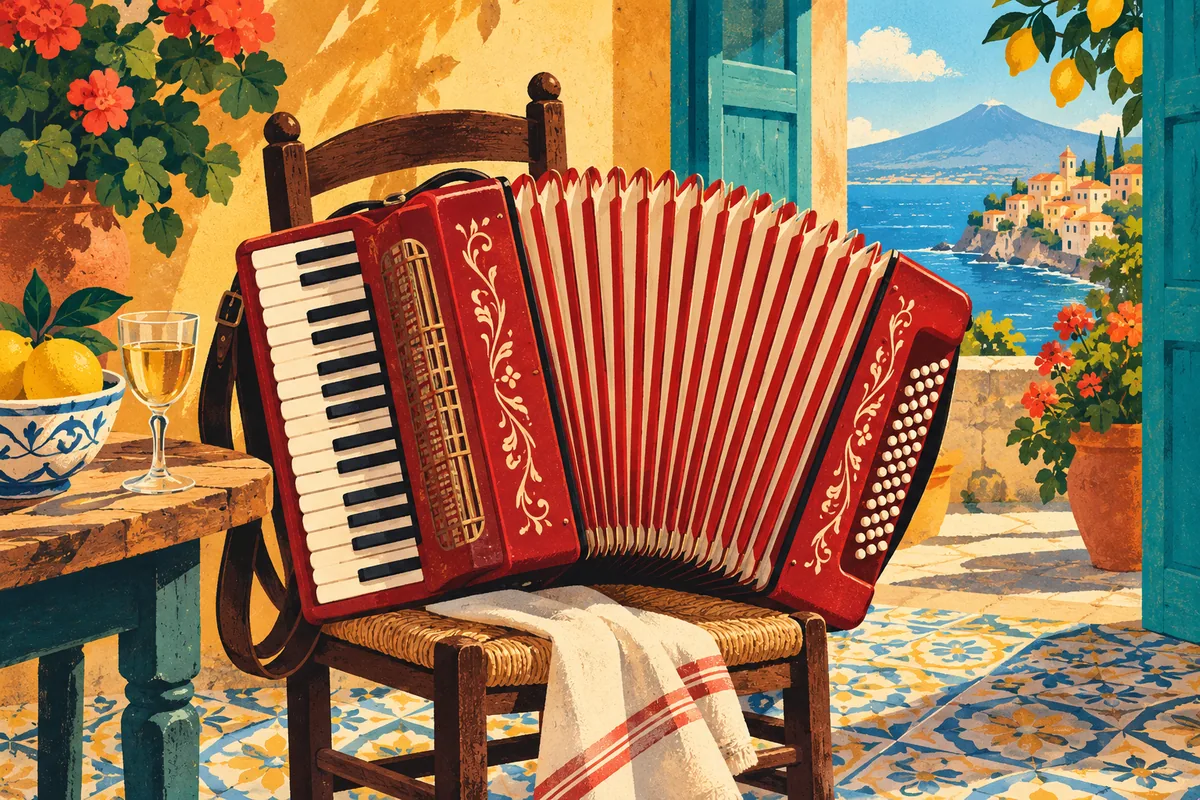
The thing had shoulder straps. It had bellows. It had switches. It had keys. It had hundreds of buttons. Three hundred and twenty buttons on the left side alone. 320. At age eight I didn't know 320 of anything. I didn't know 320 words. I certainly didn't know 320 musical notes. Half the time I wasn't sure whether I was making music or accidentally launching a missile.
Still, every week I dutifully attended lessons. My accordion teacher was Russ Pinozotta. That name belongs in the story because it makes the whole thing real again. He wasn't just "the accordion teacher." He was Russ Pinozotta, a man who somehow looked at a room full of children strapped into portable air conditioners and thought, "Yes. This is music education."
I remember walking into those lessons with the red velvet case in my hand and the same private hope every week: that somebody would stop the lesson halfway through and announce, "Good news. There has been a terrible mistake." Nobody ever did.
Russ taught. I listened. The accordion breathed in and out like a patient with sinus problems. My left hand searched for buttons I could not see. My right hand tried to behave on the keyboard. My shoulders slowly learned that childhood could include manual labor.
That was how I entered the very exclusive world of South Jersey accordion players. Exclusive because there were only three of us. Three. Not three in my school. Not three in my neighborhood. Three in the entire town of Hammonton. Today, if a town has only three accordion players, nobody notices. Back then, in a heavily Sicilian community, it was practically a public utility.
The three of us were Benny Massara, Vincent Mento, and me. Of course nobody called us that. This was a Sicilian town. Nobody used real names if a nickname was available. Nicknames were mandatory. Somehow the federal government could issue birth certificates and Social Security cards, but the neighborhood still had final authority.
Benny Massara was known as "The Stud." Even at ten years old we were convinced Benny had romantic experience. We had absolutely no evidence. Not a shred. But Benny possessed all the necessary qualifications. He had perfect hair. Not ordinary hair. Elvis hair. Hair that looked as though it had its own management team. Hair that could survive a hurricane. Hair that probably had voting rights. Benny also had confidence, the kind of confidence normally found only in politicians and people who don't know what they're talking about. He could walk into a room and instantly make everyone else feel slightly underdressed. Even in gym class. Especially in gym class. If Benny had entered the priesthood, women would have followed him into the monastery.
Then there was Vincent Mento, known universally as Lumpy. Why was he called Lumpy? I have no idea. Nobody knew. Nobody asked. In a Sicilian neighborhood, there were simply certain subjects that remained unexplored. The nickname fit. That was enough. If somebody introduced him as Vincent, half the town wouldn't have known who you meant. Say Lumpy and everybody knew immediately. That was the power of nicknames.
Then there was me. My nickname was Big. Sometimes Jumbo. Neither one required much explanation. I was a large child. Not enormous. Just noticeably larger than the average kid. I liked food. Food liked me. The relationship was mutual. One summer I decided I was going to become a surfer. This decision made absolutely no sense. I lived in New Jersey. I had never demonstrated any athletic talent involving balance. And I weighed enough that the laws of buoyancy were forced to hold an emergency meeting. Nevertheless, I acquired a surfboard. On the bottom, in giant letters, somebody painted:
JUMBO
Nothing builds confidence quite like carrying a surfboard with your nickname written across it in letters visible from low Earth orbit. I would walk down the beach pretending not to notice. Everyone else noticed. Years later I discovered my true surfing talent. Channel surfing. I remain exceptionally gifted.
The Stud, Lumpy, and Jumbo formed what may have been the least threatening musical group in American history. The Beatles had Shea Stadium. We had Roselli's Barbershop. The Rolling Stones had Madison Square Garden. We had Miss Mazzagatti's clothing store. And not just the store. The window.The actual display window.
To this day I still don't fully understand the business logic. Somebody apparently looked at a clothing display and thought, "You know what would increase sales? Three accordion players." And somehow that plan was approved. So, there we sat. Behind glass. Three boys. Three accordions. Being observed by pedestrians. Like cannoli.
People would stop and stare. Children pointed. Adults smiled politely. Nobody screamed. Nobody fainted. Nobody asked for autographs. The closest thing we had to groupies was a guy waiting for a haircut. Looking back now, I realize I never actually loved the accordion. I tolerated it. The way people tolerate taxes, jury duty, or relatives who stay two days longer than they should.
But I did become good enough to play. Not great. Let's not get carried away. Nobody from Juilliard was coming to Hammonton looking for me. Still, I could play. And over time I began to understand that the accordion itself wasn't the point. The point was where it took me. One of those places was Roselli's Barbershop.
If you grew up in a small Italian town in the 1950s and early 1960s, you know that the barbershop wasn't just a place to get your hair cut. It was the town newspaper. The town council. The stock exchange. The rumor mill. The Supreme Court. And occasionally the psychiatric ward. Men sat in chairs discussing politics, baseball, religion, weather, and people who weren't present to defend themselves. In no particular order.
The smell hit you before you even opened the door: talcum powder, hair tonic, aftershave, cigars, and whatever mysterious chemicals were required to keep Italian men's hair looking exactly the same for forty years.
The barber pole turned slowly outside. Inside, old men occupied chairs that seemed permanently assigned to them. Some of those men may still be sitting there today. I was never completely sure.
As a kid, entering Roselli's felt like walking into a private club where everyone already knew everyone else's life story. And somehow, on certain occasions, somebody thought it was a good idea to place three accordion players in the front window. Even now I struggle to understand the marketing strategy.
Imagine you need a haircut. You walk down the street. You glance toward the barber shop. And there, behind the glass, sit Benny, Lumpy, and Jumbo pumping accordions. Was the expectation that customers would say, "Honey, forget dinner. We have to get over there immediately"? To this day I don't know.
What I do know is that people stopped. People stared. Children pointed. And we sat there trying to look professional, which was difficult because none of us had any idea what professional accordion players looked like. The Stud looked cool because Benny always looked cool. Lumpy looked confused because Lumpy always looked confused. And I looked sweaty because carrying an accordion in July was basically a cardiovascular workout.
The truth is that we weren't really performers. We were props. Italian props. Musical decorations. Like ceramic grapes, except louder. Occasionally we marched in parades. This sounds more impressive than it was. The challenge wasn't playing. The challenge was walking. An accordion is not a marching instrument. An accordion is a commitment. A long-term relationship. You don't carry an accordion. You negotiate with it.
Which brings me to a confession. We were not always playing. Sometimes we were merely moving. Accordion lip-syncing. As long as the bellows went in and out, people assumed music was occurring. Frankly, some of our best performances happened that way. At least nobody could hear the mistakes.
Yet there was something wonderful about it. Everybody knew us. Everybody knew our parents. Everybody knew our grandparents. The entire town seemed connected by invisible threads. Back then I didn't appreciate that. As a child, familiarity feels normal. You assume every town works that way. Only later do you discover how rare it was.
The place where I truly earned my accordion stripes wasn't Roselli's. It wasn't the parades. It wasn't the clothing store window. It was Christmas. Christmas in a Sicilian-American household was not a holiday. It was an event. A production. A military operation requiring months of preparation. Food appeared in quantities normally associated with disaster relief efforts. Relatives emerged from every direction. People arrived carrying trays, bowls, cakes, cookies, bottles. Nobody came empty-handed. I don't think it was physically possible. The table stretched forever. Voices overlapped. Children ran through the house. Adults told stories. Everybody talked at the same time. Nobody listened. And somehow communication occurred anyway.
My grandfather sat at the center of that universe. Not because he demanded attention. Because he naturally attracted it. Like gravity.
I wish I could tell you exactly how many Christmas dinners we shared. I can't. As children we assume there will always be another Christmas. Always another dinner. Always another story. We don't realize we're collecting memories until years later.
After dinner there would come a moment. The dishes had been pushed aside. Coffee had appeared. The noise level dropped slightly.
Then my grandfather would look in my direction. And he would say: "Jerry. Play Oh Maria."That was it. No discussion. No vote. No negotiation. If my parents had sentenced me to the accordion, my grandfather had sentenced me to Oh Maria. Every Christmas. Without fail.
I would disappear for a few minutes and return carrying the accordion. The red velvet case always seemed larger than I remembered. The clasps would click open. The smell of the instrument would drift out. Even today I can remember it. A mixture of leather, wood, age, and memory. I would slip the straps over my shoulders. The room would quiet. Not completely. Nothing ever became completely quiet in our family. But quieter. Then I would begin.
Now let's be honest. I wasn't exactly dazzling anyone. Nobody was about to offer me a recording contract. My technique was adequate. My enthusiasm varied. My timing occasionally wandered off and needed directions home. But my grandfather loved it. And because he loved it, everyone else listened.
At the time I thought they were listening to the music. Years later I realized they were listening to something else. They were listening to family. The song itself almost didn't matter. The accordion represented continuity. One more Christmas. One more year. One more gathering. One more opportunity for everyone to be together.
The music was simply the soundtrack. I understand that now. I didn't understand it then. Then I was just a kid wondering why I couldn't be outside playing baseball. But age changes perspective. As the years passed, people disappeared. Grandparents. Aunts. Uncles. Neighbors. The old men from Roselli's. The voices became memories. The chairs became empty. And gradually I realized that my grandfather had never really been asking for "Oh Maria." What he was really saying was: Let's hold onto this moment for a little longer. The accordion wasn't important. The family was. The music wasn't important. The people were. And every Christmas, for a few minutes, the accordion brought all of us together.
I especially remember the last Christmas before my grandfather died. Of course, I didn't know it was the last one. That's the thing about lasts. They rarely introduce themselves. Nobody announces, "Pay attention, this is the memory you will keep for the rest of your life." It was just Christmas. The food. The voices. The table. The old rhythms of family. And then, as always, my grandfather looked toward me. "Jerry. Play Oh Maria."
I must have done what I always did. I opened the red velvet case. I put on the straps. I played the song. The notes were probably no better than they had ever been. But he smiled. That smile is what stayed. Not the performance. Not the instrument. The smile.
I played my final Christmas performance in 1963. I didn't know it was the final one. Nobody ever knows. When it was over, I carefully placed the accordion back into its red velvet case. I closed the lid. Snapped the clasps shut. And carried it away.
I had no idea that one day I would miss those Christmases far more than I missed the accordion.
As children, we are often living inside history without realizing it. Only later do we discover that ordinary moments were actually extraordinary. By then, of course, the people who could explain everything are gone. That is one of the cruel tricks of aging. The questions arrive after the answers have left.
Meanwhile life continued. School. College. Work. Marriage. Children. Responsibilities. The accordion slowly disappeared from my life. Not dramatically. Quietly. One day I played it. Then one day I didn't.
The years accumulated. Eventually the accordion ended up resting inside its red velvet case. Stored away. Waiting. Like an old photograph. Or a memory. Or perhaps a question. Thirty-three years passed.
Then, in 1996, I sold it. I remember watching it leave. The red velvet case. The familiar shape. The instrument that had once felt so important. And then it was gone. I assumed that chapter of my life had ended. I was wrong. Because something strange happened. The accordion refused to stay gone.
IBM sent me around the world. At various times, my work took me to Europe, Asia, Australia, Africa, and South America. I visited places my grandparents could never have imagined. Cities. Villages. Capitals. Remote corners of the world. And somehow the accordion kept finding me.
In Italy. Of course, Italy. In Germany. In Croatia. In Austria. In little villages whose names I couldn't pronounce and couldn't find again on a map. Everywhere I traveled there seemed to be an accordion player. Sometimes they were performing. Sometimes they were sitting outside a cafe. Sometimes they were entertaining tourists. Sometimes they were simply playing for themselves.
Whenever I saw one, I stopped. I always stopped. Then I would ask for a photograph. The resulting pictures became strangely predictable. One actual accordion player. One actual accordion. And one retired impostor. Me. Standing beside them. Smiling as though I belonged. I still have those accordion photographs today. All of them. They form a strange little archive of my life: travel, memory, aging, curiosity, and the persistence of an instrument I never wanted in the first place.
One photograph stands out more than the others. Greece. Carol took the picture. I was standing there with a big brace on my knee because of an injury. It was not exactly the heroic travel portrait one hopes to leave for future generations. There I was, older, injured, braced, and still somehow drawn toward an accordion. The person playing was a beautiful young woman. She had the instrument in her hands, and for a moment the whole scene felt almost impossible to me.
A little Sicilian-American boy from Hammonton had once been sentenced to accordion lessons by his parents. He had played in barbershop windows with The Stud and Lumpy. He had performed "Oh Maria" for his grandfather at Christmas. He had packed the accordion away in its red velvet case. He had sold it after thirty-three years of silence to Jim Seamark of Rockville, NY.
And now, decades later, he was standing in Greece with a knee brace while his wife took his picture beside a beautiful young woman playing an accordion. Life is not efficient. But it is sometimes poetic. At first, I thought those photographs were pictures of accordions. Then I thought they were pictures of travel. Eventually I realized they were neither.
They were photographs of memory.
Every accordion reminded me of something. Roselli's Barbershop. Miss Mazzagatti's window. Russ Pinozotta. The Stud. Lumpy. Christmas. My grandfather. The Bull. My father. Carol behind the camera in Greece. The photographs became a map. Not a map of geography. A map of people. And that realization changed everything.
For most of my life I believed the accordion was the story. It wasn't. The accordion was never the story. The accordion was the key that unlocked the stories. Every place it pointed contained somebody I loved, somebody I remembered, or somebody who helped explain where I came from.
My grandfather. My father. Russ Pinozotta. Benny The Stud. Vincent Lumpy Mento. Carol. The little Sicilian town that somehow produced all of us. The accordion connected them. Without it, many of those memories might have drifted away.
Instead, every time I saw one, the map unfolded again. And I found myself back home. Back in Hammonton. Back at Roselli's. Back at Christmas. Back listening to voices that have long since fallen silent. Back in a world that no longer exists except in memory.
As I sit here today, I can still hear my grandfather. The dishes have been cleared. Coffee has been served. The family is gathered around the table. The room is warm. The conversation is loud. And then comes the familiar voice.
"Jerry." A pause. "Play Oh Maria."
I reach for the accordion. The red velvet case opens. The straps settle onto my shoulders. The first notes begin. And for a few precious minutes everyone is together again. That is what I remember now.
Not the instrument.
Not the buttons.
Not the parades.
The people.
Always the people.
Because in the end, the accordion was never the story.
Love was.