As my college graduation approached, I was looking at three possible futures. One was a power company in Detroit. One was a shipbuilding company in Virginia. And one was IBM in East Fishkill, New York. The power company sounded solid. The shipbuilder sounded important. But IBM felt like the future had sent me a personal invitation. Back then, IBM was not just a company. IBM was white shirts, black ties, polished shoes, mainframe computers, and people who looked as if they had never once spilled anything on themselves.
I wanted that job badly. I knew even then that my whole life could turn on it. Different job, different city, different people, different version of me. And I almost lost it because of a piece of chicken, a snowstorm, a taxi in a ditch, and a pair of pants that quit in public. I was a senior at the University of Dayton studying electronics and integrated circuits. Integrated circuit chips were new enough that if you knew anything about them, people treated you like you had been handed a note from the future.
I was also 303 pounds, with a beard, a generous amount of 1960s hair, and a wardrobe that did not say IBM so much as, maybe this young man knows a guy who can fix your stereo. But I had a plan. I bought a suit. When you weigh 303 pounds, buying a suit is not shopping. It is procurement. It is a capital project. You do not stroll into a store and say, Do you have this in my size? You enter a big-and-tall store and say, What here is willing to become a suit with enough tailoring and prayer?
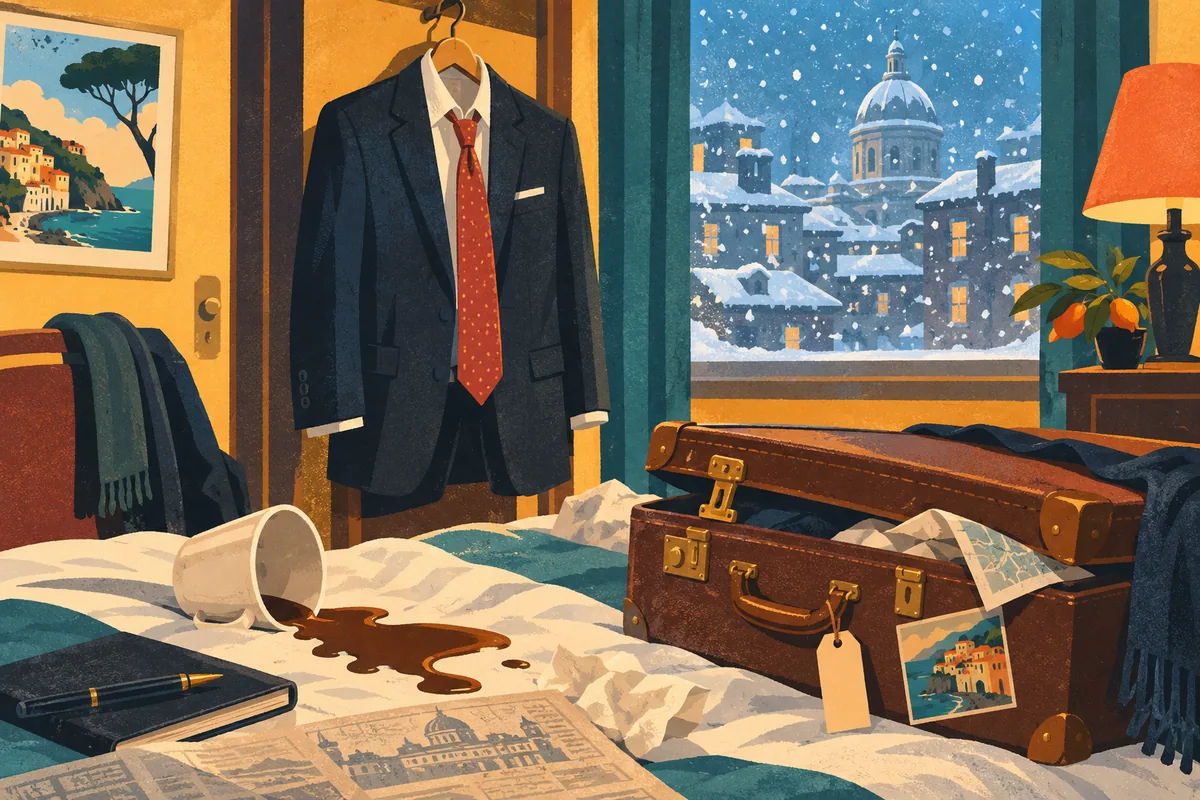
I bought the suit. I bought the overcoat. I bought gloves. I packed the professional version of Jerry carefully in my suitcase. Unfortunately, the version of Jerry who boarded the airplane was the existing model: flag sneakers, psychedelic shirt, beard I planned to shave at the motel. This was my first time flying, and on the plane they served Chicken Cacciatore. I thought, well, this is glamorous. Air travel comes with Italian food.
Then I tried to cut the chicken with the airline knife, which had the cutting power of a playing card. I pressed a little harder. The chicken slipped, the sauce launched, and suddenly my psychedelic shirt and the Chicken Cacciatore became one integrated system. I did not panic. The suit was in the suitcase. IBM Jerry was still safe.
Then I landed at LaGuardia and learned that my luggage had been lost. I did not even know luggage could be lost. I thought luggage was luggage because it traveled with you. That was the job description. But apparently my suit, razor, clean shirt, and dignity had all decided to pursue independent careers. IBM had reserved a motel room about two hours away. I got into a taxi. Shortly after we left the airport, snow flurries started. Then the flurries became snow. Then the snow became a storm. By the time we reached the motel, there were six to eight inches on the ground, and more was still coming down.
That night I looked at myself in the mirror. Flag sneakers. Psychedelic shirt with a chicken-based mural. Beard I could not shave. No suit. The only professional thing I had left was the overcoat. So the next morning, the overcoat became my strategy. I got into a taxi for the first appointment of the most important interview day of my life, and because the roads were icy from all that snow, the taxi ran off the road.
The driver and I sat there for a moment, looking at the snowbank, two men whose plans had been rejected by physics. Now I was not only underdressed, stained, unshaven, and missing my luggage. I was late. Late to IBM. Late to the first appointment. Late to my own future. Eventually I made it to Building 320 and asked for the recruiter. I told him the whole story: the lost luggage, the snow, the taxi, the chicken, the beard. He listened very calmly and said, Do not worry. Just explain it to each manager.
That sounded reasonable. It also sounded like something a man says when he is not wearing the chicken shirt. IBM East Fishkill was enormous. You took shuttles from building to building. So I left Building 320 for my first interview. I walked outside, stepped onto the ice, slipped, and ripped my pants straight up the middle. All the way up.
If my shirt said Woodstock, my pants now said rodeo. In that moment, I reorganized my problems. The beard, the sneakers, the stain, the lateness - all of that moved down the list. The pants moved to number one with a siren on top. From then on, the overcoat was no longer clothing. It was a containment system. It was a legal requirement.
I went through the first interview. Then the second. I sat carefully. I stood carefully. I walked like a man transporting unstable chemicals. By the time I got back to Building 320 for the final interview, I was not thinking, I hope I impress them. I was thinking, please, Lord, let me leave this campus without becoming an incident report.
The receptionist called the hiring manager’s secretary. On the way to his office, we passed a coffee machine, and the secretary said, Would you like a coffee? Nobody teaches you the coffee rules for a corporate interview. Do you say yes? Do you say no? If you accept, when do you drink it? Is IBM testing cup discipline?
At that point I figured I was not getting the job anyway, so I said, yes, I would love one. The secretary bought one coffee for me and one for the hiring manager. She led me into his office. I sat at an L-shaped table, about three feet from the door. I put my coffee down and made my first executive decision of the day: I would not drink mine unless he drank his.
That felt like leadership. The hiring manager introduced himself. I introduced myself. I told him a shortened version of the day, because there are facts and then there are liabilities. Then his phone rang. He picked it up, and I thought, this is my moment. I will take a calm, professional sip of coffee while he is on the phone. He will look over and see a young man who has endured transportation failure, luggage loss, weather, torn clothing, and poultry impact, yet remains composed.
I lifted the cup. At that exact second, the secretary opened the office door to hand him some documents. The door hit my arm. The coffee flew across the table. It went everywhere. The hiring manager jumped up. The secretary jumped in. They grabbed paper towels. I sat there watching the coffee move toward his papers with more confidence than I had shown all day.
The coffee had ambition. The coffee was networking. And in my head, I reviewed the evidence. Flag sneakers. Chicken shirt. No razor. Taxi in a ditch. Late arrival. Ripped pants. Overcoat I could not remove. And now I had attacked the hiring manager's office with coffee. Nobody survives that. But the hiring manager did not send me home.
Instead, he called one of his engineers into the office. They asked me questions about work habits, problem solving, how I thought through situations. Those I could handle. I could still talk. I could still reason. I could still pretend the overcoat was a choice. Then the engineer said, Jerry, would you go to the whiteboard and draw a multivibrator circuit?
Now, a multivibrator is a real electronic circuit. It has two transistors and makes pulses. It is not what the name sounds like. Although at that moment, I was definitely the one vibrating. This was the first question of the day I could not talk my way around. The overcoat could not help me. A joke could not help me. An explanation could not help me.
You either know the circuit or you do not. I walked to the board. I remembered that there were two transistors at the top, so I drew them. Then I looked at those two transistors, and something happened. The rest came back. The resistors. The capacitors. The cross-connections. The whole thing. I drew the circuit. And it was right.
For the first time all day, I was not the big kid in the wrong clothes. I was not the beard, the flag sneakers, the chicken stain, the ripped pants, or the coffee spill. I was the guy who knew the circuit. The interview ended. I went through the standard IBM medical exam. The next day, at the airport, there was my luggage. The suit had arrived exactly when it was no longer useful, like a witness showing up after the verdict.
A few weeks later, I graduated and went home to Hammonton, New Jersey. Three weeks went by with no word from IBM. My father asked for an update. I told him I had not heard anything. He said, Call the recruiter and ask him how much it will cost to get you the job. My family is Sicilian, so that was not a joke. That was career counseling.
I finally got the nerve to call. The recruiter answered, and I said, This is Jerry Perone. He said, Oh, I just completed your paperwork and was getting ready to call you. Pretty insightful that you called me. Then he told me IBM was making me a formal offer. I would become a junior engineer, working for the man whose office I had baptized with coffee.
I went quiet. Because I understood, even then, that this was not just a job. This was the turn. The power company would have been one life. The shipbuilder would have been another. IBM became mine. I have thought about that interview for more than fifty years. Why did they hire me? It was not the suit. The suit was missing. It was not polish. I had none. It was not because I looked like an IBM man. I looked like a snow-covered folk singer who had lost a knife fight with lunch.
But every time something went wrong, I kept going. I kept explaining. I kept getting into the next taxi, the next shuttle, the next chair. I kept the overcoat closed and walked to the next room. And when the moment finally came that required what I actually knew, I was ready. At 303 pounds, I had spent a long time believing people would only see what was wrong with me. That day, I gave IBM every possible reason to do exactly that. But at a whiteboard in Building 320, for one perfect minute, there was no shirt, no snow, no coffee, no pants, no shame.
There was just the work. I took the job at IBM. And ever since then, whenever someone says, dress for the job you want, I think, yes, absolutely, do that. But also remember this: sometimes your whole life turns not on the suit you packed, but on the one thing no airline can lose.