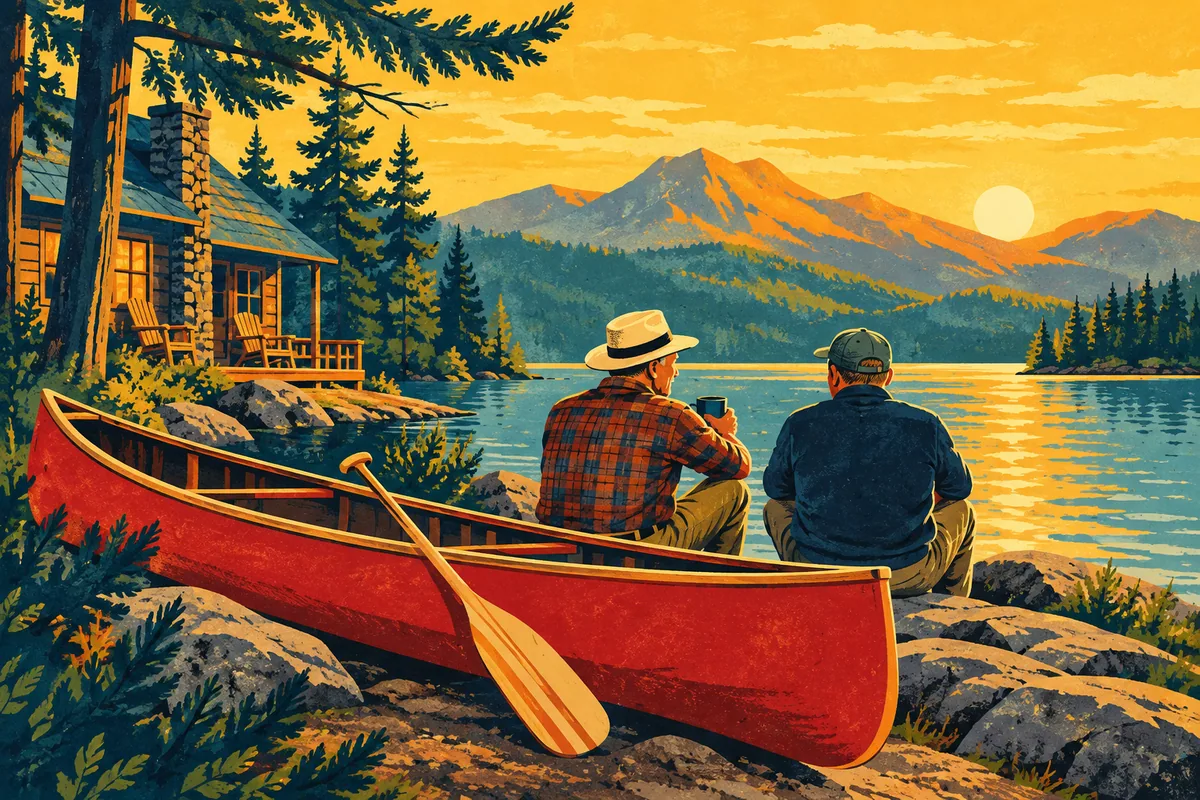
Some great traditions begin with a vision.
Ours began because I stood up in a canoe to pee.
The Adirondack Mountains of upstate New York hold some of the most beautiful wilderness in America, and wilderness, I learned, has very firm opinions about human stupidity. Running through it is the Raquette River, a ribbon of clean mountain water connecting Long Lake with Tupper Lake — miles of remote forest, interrupted by Raquette Falls and its infamous carry: roughly a mile of hauling canoes, food, tents and sleeping bags up and over a mountain.
It was Memorial Day weekend, 1973.
Five months earlier, on January 3, I had taken Carol Cohen to see Deliverance on a blind date at the Vassar College movie theater. Most men choose a romantic comedy. I selected a terrifying movie about four men taking a canoe trip through the wilderness and barely making it home alive. Nothing says would you like to build a future with me quite like banjos, violence and canoe trauma.
She married me anyway, on April 28, 1974. We have now been together more than fifty-three years — and she remains the only woman I know who watched Deliverance with me and thought, I should spend the rest of my life with this man.
Remember that she is a patient woman. It becomes relevant.
In 1973 I was working for IBM in East Fishkill, New York, about five hours from Long Lake. My friend Bob Parridy mentioned that he and an older gentleman he knew were planning to paddle from Long Lake to Tupper Lake. I asked whether my college friend Mike Vass and I could come along.
Bob's friend was also named Mike. He was around sixty, had run the Raquette many times, knew the outfitters, and had made every arrangement.
This gave our expedition two Mikes, one Bob and one Jerry, which meant that for four days any sentence beginning with "Mike—" produced two responses and no useful information. To keep this readable I will call the older man the Commodore, which is what he eventually became, though at the time he was simply the only man among us who knew what he was doing.
That was not Jerry.
He agreed to take us. Reluctantly. In retrospect, his reluctance demonstrated excellent judgment.
On Friday afternoon, Mike Vass and I loaded the car and followed Bob and the Commodore north. We dropped the canoes and gear at the outfitter in Long Lake and left our cars there.
The plan was beautifully organized. At seven Saturday morning we would paddle the length of Long Lake — about four hours — then enter the Raquette River and continue five miles to Raquette Falls, arriving around four to make camp. The term campsite may be generous; there was no level ground, and we would be sleeping on the side of a mountain, flat terrain apparently being considered an unnecessary luxury. Sunday we would break camp and complete the carry, two men to a canoe, then walk back for the tents and food. Four days later the outfitter would meet us at the Tupper Lake Marina.
We had routes, schedules, food assignments, campsites, and transportation. We had planned for cold, rain, insects, terrain and a one-mile carry.
We had planned for everything.
Except my bladder.
Eisenhower said, "Plans are worthless, but planning is everything." He was right. He had planned the invasion of Normandy. We had failed to develop a canoe urination policy.
At seven Saturday morning the four of us pushed off. It was cold, but the lake was spectacular — water clear straight to the bottom, mountains standing up all around us.
For four hours, everything went according to plan.
Then, around eleven, just short of the mouth of the Raquette, I had to pee.
There were no docks. No convenient shoreline. No restrooms. And not one floating porta-potty anywhere on Long Lake.
So, I made what seemed, at the time, like a perfectly reasonable decision.
I stood up in the canoe.
Experienced canoeists know that standing in a canoe is a hard no. A canoe is a narrow boat specifically designed to punish vertical ambition. I was not an experienced canoeist. I unzipped my pants and began taking care of business.
Some distance off, the Commodore turned around. I have never forgotten his face. It was not alarm. It was the expression of a man watching something he had warned about, in writing, at a briefing, being done anyway.
Then without changing a muscle on his face the Commodore yelled, "NOOOOO.OO! What are you clowns doing?" Then physics conducted an unscheduled performance review.
The canoe flipped.
Mike Vass and I went into Long Lake.
The water was unbelievably cold — ice had been on that lake only weeks earlier. One moment we were admiring the scenery. The next, the canoe was upside down and everything we owned was heading in a different direction. Food, tents, clothing, sleeping bags, paddles and my remaining dignity, all drifting toward the Raquette River.
Our expedition went from DEFCON 5 to DEFCON 1 in about four seconds.
Bob and the Commodore went after the canoe and the gear. Mike and I had to get out of the water, and Mike was in trouble — shivering too hard to hold a sentence together, and then vomiting from the cold.
One of Long Lake's islands lay about a quarter mile off, closer than the mainland. We swam for it.
A quarter mile does not look far from inside a canoe. From inside freezing water, it looks like Europe.
I remember counting strokes and losing count and looking over at Mike and not being able to tell whether he was still swimming or just being carried by the last of whatever he had.
As we got close, people came out of a large house and ran down toward the rocks. They had seen the whole thing.
Several of them reached down and hauled us out. Mike and I lay there on the rock, soaked and shaking and breathing like we had been shot.
Then Mike leaned over and whispered:
"Car 54, where are you?"
I stared at him. I had no idea about what he was talking. I assumed hypothermia had turned his brain into a television schedule.
They got us on our feet and started walking us up toward the house. The man on my left had his hand under my arm, and the top of my head came to somewhere around his shoulder.
A few steps later Mike whispered again:
"Fred Munster."
That was not technically the character's name, but this time I understood.
I looked up.
It was Fred Gwynne.
Before he played Herman Munster on The Munsters, Fred Gwynne had spent two seasons as Officer Francis Muldoon on Car 54, Where Are You? Mike had grown up on both shows. I had apparently grown up under a rock.
He was six feet five. Up close, out of the makeup, in ordinary clothes, he did not look like a monster at all. He looked like a very tall man whose holiday weekend had been interrupted by two idiots in the lake.
What I remember is that he was completely unbothered. Nobody made a fuss about who he was, and he did not invite anyone to. He was simply the tallest man at the scene and therefore the one doing most of the lifting.
He just casually reached down, extended the longest arm that I had ever seen and said, "Was there something wrong with the dock or do you fellows always arrive this way or is this a special occasion?”
Inside, they built up the fire, wrapped us in blankets, found us dry clothes, and put hot food and whiskey and water in front of us. They hung our clothing and our sleeping bags near the hearth and did everything possible to get us warm.
Apparently, in 1973, whiskey was standard wilderness medicine. It is in fact exactly the wrong treatment for hypothermia — alcohol opens the blood vessels and dumps your core heat straight into your skin. Nobody in that room knew it, and I have never been more grateful for bad medical advice in my life.
Mike and I kept looking at each other.
A few hours earlier we had been four ordinary men beginning a canoe trip.
Now Herman Munster was drying my underwear.
Eventually Bob and the Commodore arrived with the overturned canoe and as much of our equipment as they had managed to recover. They were given the same treatment and accepted it gratefully, though the Commodore's gratitude carried a certain quality. He had run that river for years without incident. He had now been rescued, in front of witnesses, on day one, four hours in, because of a bladder.
Fred Gwynne was there with family and friends.
Later, once we had warmed up, somebody produced a volleyball.
There is no dignified way to describe what followed. I had capsized a canoe while urinating, swum a quarter mile through ice water, been pulled out by strangers, and been dressed in another man's pants. I now found myself on the wrong side of a net from a six-foot-five television monster who did not appear inclined to take it easy on me.
He did not take it easy on me. He barely had to leave the ground.
Nothing restores a man's dignity after capsizing mid-urination quite like having Herman Munster spike a volleyball into his face.
Needless to say, our carefully planned wilderness expedition was over.
Our rescuers had a powerboat. After dinner they loaded the four of us, our canoes and everything we still owned, and ran us back across Long Lake to the outfitter. We checked into the lodge and stayed the night.
That evening, I called Carol.
I would like to report that I led with the part about Fred Gwynne. I did not. I led with the part about being alive, having already learned that you establish the headline before you introduce the entertainment.
Carol in that loving pissed off voice grumbled disappointingly, "are you kidding me? Just like your mother said. You are like a bull in a China shop."
We never reached Tupper Lake. We never paddled the Raquette River. We never completed the Raquette Falls Carry.
But we had been rescued, warmed, clothed, fed and thoroughly beaten at volleyball by Fred Gwynne.
We went looking for the Raquette River and found prime-time television.
Most rational people would have treated that as a warning.
I treated it as a pilot program.
A year later I organized a return expedition and invited Mike Vass. His answer was immediate and unambiguous:
"Never again."
Mike had survived freezing water, hypothermia, and my decision-making. A wise man knows when he has used up all his luck. He has never been back on that river, he has never let me forget any of it, and fifty-three years later he still tells the story better than I do — mostly because in his version he is the one who notices Fred Gwynne, which, to be fair, is true.
So, I went back with two of my housemates and another IBM friend. We did not merely repeat the original route. We expanded it. We started at Old Forge, adding roughly miles 54 miles and several additional carries before continuing through Long Lake and the Raquette River to Tupper Lake.
IBM had taught me that when a project fails, you do not necessarily make the next attempt easier.
You increase the scope.
The first expedition had exposed a serious bladder-related design defect. I corrected it. I remained seated.
We completed the entire route from Old Forge to Tupper Lake. The Raquette River had not defeated me. It had merely enrolled me in remedial canoeing.
We had such a good time that the following year we brought two more friends: six men, three canoes. Those six became the core of the thing.
Year after year we came back. More men joined, more canoes appeared, the stories got bigger and the parties got louder, and the expedition became a legend throughout IBM. Among young IBM men, documented evidence of bad judgment turned out to be an extremely effective recruiting tool.
By the tenth-anniversary expedition we were twenty-four men and twelve canoes. At that size you cannot simply say, "Everybody get in a canoe and follow Jerry." Besides, IBM could not tolerate twenty-four people enjoying themselves without an organizational chart.
So, we used the management training IBM had given us. It had probably not intended for that training to be applied to twenty-four men carrying beer through the Adirondacks, but education is education.
We divided into three groups, eight men and four canoes each, with a group commander over each and a boat captain in every canoe. The commanders and captains were officers. Naturally, the officers required uniforms — special hats, homemade epaulets, and strips of duct tape across the back of the shirt to indicate position and rank. The United States Navy used gold braid. The IBM Raquette River Navy used hardware-store tape.
Each group got a different color T-shirt, and responsibilities were assigned down to the individual canoe: equipment, food, campsite setup, breakdown, safety, cleanup and transportation. We had accountability, delegation, and a clearly defined chain of command.
Even the Adirondack bears knew exactly whom to blame.
Each commander needed a flag so his canoe could be identified, and we mounted those flags on short toilet plungers — which made us, to my knowledge, the only navy in the world whose senior officers could command a fleet and unclog a toilet with the same ceremonial staff.
Before departure I ran a formal pre-trip briefing: full plan, organizational chart, command structure, officer ranks, individual responsibilities, routes, equipment, schedules and campsite procedures. We were twenty-four grown men about to paddle canoes through the woods, and we had built a management structure suitable for invading a small country.
At the conclusion of the briefing, we played the theme from Rocky. As those opening trumpets filled the room, twenty-four men in colored T-shirts, homemade officer insignia and duct tape marched out feeling ready to conquer the world.
Or at least five miles of river.
It became the official expedition music. Every morning as we broke camp, it played. Tents came down, sleeping bags were rolled, canoes were loaded, commanders raised their toilet plungers, and somewhere in the forest deer fled in confusion.
Deer was one thing, but this is a posted New York State Wilderness. The first thing that meant was that if you got into trouble no one was coming for you. There was no Lincoln Dale of the Everglades. No patrol boats. No helicopter continually scouring the river looking for survivors. You were on your own and you had to take every precaution. The one doomsday scenario that we were all worried about was bears. We had frequently seen them off in the distance. We had also seen signs that said, "Caution: Bear Country". Maybe the signs should have said, "STOP! BEARS. DO NOT ENTER." Then one night it happened. There was ten of us altogether which meant that there were five tents and lots of edibles. Tents have usually six ropes for each tent. These ropes had to be pulled tight and fastened to the ground with stakes. We had 30 long ropes in complete disorder. As we were all sufficiently scared of a Bear attack, we followed every safety instruction given by New York State. Keep a fire burning. Put all unused food in sealed containers and hang these containers high in a nearby tree at least 15 feet above ground. In addition, it was recommended that each person wash their face and brush their teeth before going to sleep in your tent, your home away from home. This was so a Bear would not smell food and come into your tent to eat everything including us. My tent had a little window in the back about twelve inches wide and eight inches high. Then one night it happened. While we are all tucked snuggly in our sleeping bags in our cozy tent we heard a huge rustling. One of the other guys had gotten up to go wee wee and noticed that we had a visitor. A huge black bear was making a detour through our campsite. The fire did not scare him away. Me and my mate were watching the entire thing unfold through our tiny window. We saw the bear looking all around, up, and down. Then he noticed our food hanging just for the picking. He ripped everything down and started putting everything in his mouth even several of our canteens. He found those too hard to digest and tossed then aside. He did leave his teeth marks indented in the metal. After he finished eating, he started roaming. This is when things got really scary. One trip on a rope and suddenly a Bear in your tent. Luckily after a while he walked away. We all felt relieved and lucky. After we surveyed the damage we all went back to sleep to paddle another day.
The Bear did not quelch our desire to continue our Canoe Trips. For the tenth anniversary we decided that canoes, uniforms, flags and an IBM management structure were not enough.
We needed air support.
We chartered a fleet of small four-passenger amphibious floatplanes, each carrying two canoe teams with a canoe strapped to each pontoon. From the ground they looked as though the United States Air Force had merged with L.L. Bean.
The pilots flew us over the entire Long Lake paddle and set down at the mouth of the Raquette River. The four-hour stretch where I had capsized now took minutes. More importantly, if I had to pee, we were under federal aviation regulations.
That was a powerful deterrent.
We unloaded the canoes and paddled the five miles to the Raquette Falls Carry, made camp, and stayed four nights.
We did not complete the carry.
After ten years we had progressed from canoeists defeated by a carry to IBM managers who had removed the carry from the project scope. Our objective was to reach it, admire it, and refuse to carry anything over it.
This is called strategic planning.
At the end of the expedition the planes came back, landed directly on the river, and took out all twenty-four men and twelve canoes. The wilderness expedition now included aerial insertion and extraction. Lewis and Clark would have been furious that they had not thought of this.
Every year, on the final night of the trip, we held a huge celebration called the Commodore's Ball in honor of Commodore Mike the father of our Canoe Trips — food, drinks, speeches, stories, and whatever dignity remained among men who had spent the week marching behind toilet plungers.
At the tenth-anniversary Commodore's Ball I stood before the assembled members of the IBM Raquette River Navy, announced that we had now completed ten annual expeditions, and recommended that the tenth be our last.
It was time to retire the fleet.
The canoes stopped. The men did not.
For another ten years the annual trips continued at resorts throughout the East Coast, including New Jersey and Fire Island, New York. During the final three years we expanded internationally, traveling to the Dominican Republic and Costa Rica.
As we grew older, our definition of wilderness changed. Tents became hotel rooms. Sleeping bags became clean sheets. Canoe carries became carry-on luggage. The one-mile mountain portage became the exhausting walk from the hotel bar to the elevator.
By the twentieth anniversary, careers, families and relocations had scattered most of the original twenty-four participants. But our core group of six remained.
The organized expeditions eventually ended. The friendship did not.
Today we are all in our late seventies. We no longer paddle wilderness rivers, carry canoes over mountains, or strap them to airplanes. We sit around, we drink, we play bocce, and we party on. We smoke a little weed. This is not a decline in operations. It is an updated business model.
Bocce is especially well suited to our present age. If somebody tips over during a bocce game, at least the water is not freezing. We could probably still play the Rocky theme every morning, but it might take the entire song for all six of us to get out of our chairs.
Our old command structure has evolved, too. The group commander is now whoever knows where the bathroom is. The boat captain is the designated driver. The most valuable officer is whoever remembered to bring the ice. We no longer need colored T-shirts, epaulets, or duct-tape rank insignia — after fifty-three years everybody already knows who is supposed to do what.
Nobody does it. But we know.
Carol has watched this entire operation from the beginning. She was there for Deliverance. She took the phone call from the Long Lake Lodge. She watched me leave for ten Memorial Day weekends with a duffel bag and a toilet plunger, and she has watched the survivors of that navy turn into six old men playing bocce in the shade.
Carol summed it all up saying, "Boys will be boys."
Our adventures became legends at IBM. People remembered the uniforms, the command structure, the floatplanes, the colored teams, the Rocky music, and the flags mounted on toilet plungers.
The canoes are gone. The river is behind us. The party continues — we simply hold it closer to a bathroom now.
But the real story was never about canoes, carries, or floatplanes.
Fred Gwynne thought he was helping pull two freezing young men out of Long Lake. He could not have known that his kindness would turn one disastrous weekend into the founding story of a twenty-year tradition.
If I had not stood up in that canoe, we might have completed the original trip quietly and gone home.
Instead, I fell into Long Lake, Mike nearly froze, Herman Munster rescued us, and the IBM Raquette River Navy was born.
One terrible decision gave us twenty years of adventures.
Those adventures gave us fifty-three years of friendship.
We never did find Car 54.
But we found Fred Gwynne.
And somewhere along the way, six young men found one another.