For Nick Perone—the King Pin
Eleven Minutes
I was the oldest son. Eleven minutes older than my twin brother, Nicky, but those minutes counted. To outsiders, eleven minutes is a coffee break. To twins, it is a dynasty.
So when my father bought his first tow truck, I considered the naming rights settled.
My father had come home from World War II after serving in the Pacific. Tinian was his last duty station. Like millions of returning veterans, he was ready to build a life. Some men wanted a steady job. Some wanted a house.
Daddy wanted a tow truck.
Actually, Daddy wanted every tow truck. If there had been a support group for that condition, he would have founded it, chaired it, and bought a larger truck to bring everyone to the meetings.
He opened Lakeview Garage, an automobile and truck repair and towing business in South Jersey. Officially, we repaired vehicles. Unofficially, the repairs financed Daddy’s tow-truck habit.
He loved his sons, too. I am sure of it. But the trucks had maintenance records, polished chrome, and considerably fewer opinions. A report card full of A’s earned a nod. A new transmission was news for the whole family.
There were four boys and no girls: Jerry and Nicky, then Sammy and Davey. Every name ended in a “y.” It was less a family than a ready-made fleet.
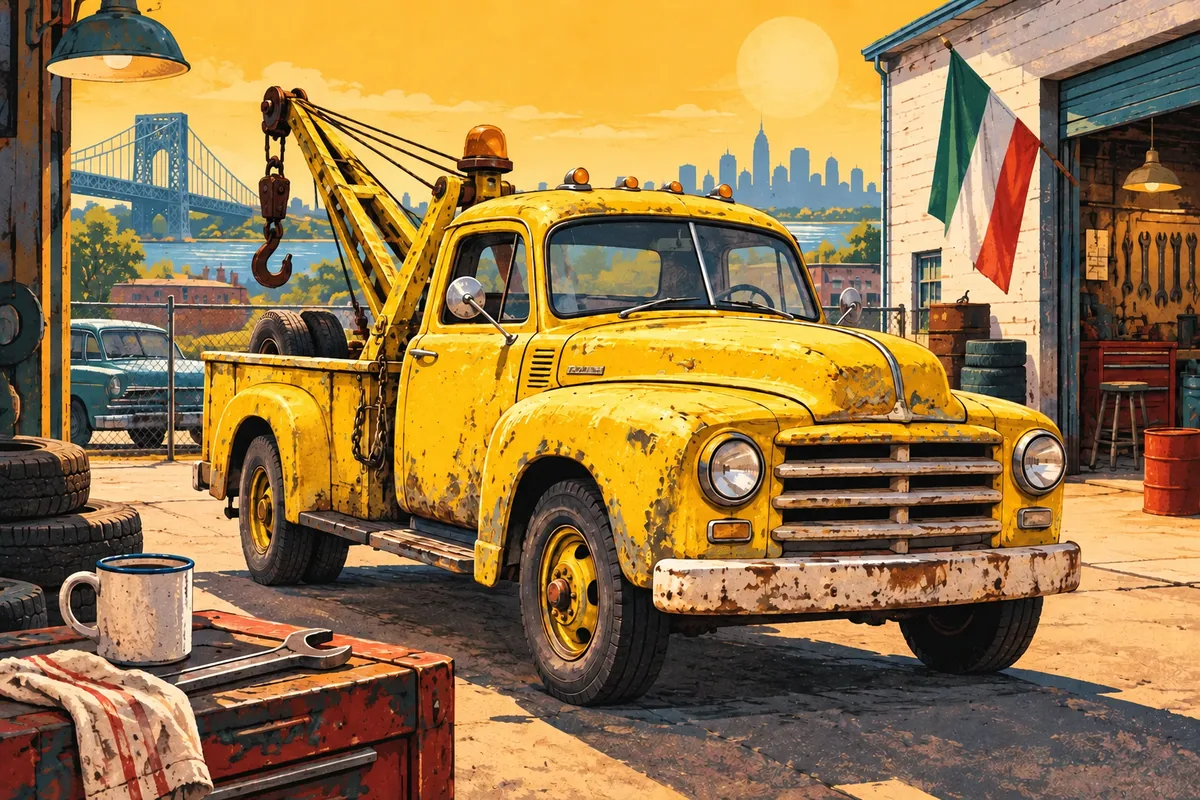
The first truck was magnificent: a brand-new, chrome-yellow 1950 Ford with towing equipment mounted on the back. It shone so brightly that pilots could probably use it to find Philadelphia. Daddy stood beside it as though he had built the whole thing himself.
Then he had a name painted on both doors.
NICKY.
I looked at the truck. I looked at Daddy. I looked at Nicky. Even the truck looked smug.
There had clearly been a clerical error. Unfortunately, our Sicilian household had no appeals process. Daddy was the trial court, the appellate court, and, when he raised one eyebrow, the Supreme Court.
I waited. Surely the next truck would be mine.
Eventually he bought it: a 1944 Dodge military-surplus truck. If Nicky belonged in a parade, this one looked as though it had lost the war and stayed behind for cleanup.
The seat appeared to have been upholstered with old socks and bed springs. The gears sounded like two coffee grinders fighting inside a steel garbage can. Starting it required considerable encouragement and, occasionally, the intervention of a saint.
Daddy painted my name on the doors.
JERRY.
Nicky got glamour. I got postwar reconstruction.
Truck Number Three was larger, newer, and better looking. Daddy named it Sammy. Number Four was larger still. Daddy named it Davey. Apparently, he ranked his sons by model year.
Over time, fifteen more machines joined the first four: thirteen tow trucks and two vehicles so large we called them cranes. Nineteen major pieces of towing and recovery equipment. Four sons.
I like to imagine my mother, Theresa, looking across the dinner table and saying, “Nick, no more children. I am done.” Not because she disliked children. Because she had noticed that each new baby required another truck.
Daddy kept buying equipment. Mommy closed the department that supplied the names.
An Education at Lakeview
On Saturday mornings, Daddy gave the fleet what would now qualify as a spa treatment. No cucumber slices, but plenty of chamois. The trucks had to be washed, dried, polished, inspected, lubricated, and admired.
He examined the cables, oiled the chains, checked the lights, and kicked the tires. I still don’t know what kicking a tire accomplishes. Daddy did it for decades, and no tire ever dared question him.
Then came the chrome. He polished it until you could check your teeth in a bumper. People drove past the garage just to look. Daddy would stand there with a rag hanging from his back pocket, arms folded, pleased with his work.
Then one of us boys would walk by.
“Your shoes need polishing.”
Working at Lakeview was part of being a Perone. Other children received allowances. We received grease. By lunchtime, whatever the assignment, you looked as though you had lost a wrestling match with an oil refinery.
We swept floors, changed tires, patched tubes, fetched parts, cleaned bathrooms, and made coffee or frozen-custard runs. We also held flashlights.
Holding a flashlight for a Sicilian father was one of the most stressful jobs in America. It did not matter where you pointed it. You were wrong.
“A little left.” Too far.
“Back.” Too much.
“Down.” Not that far.
“You trying to blind me?”
I became convinced that the correct position existed in a fourth dimension visible only to fathers. To this day, when someone hands me a flashlight, I apologize before I turn it on.
The garage smelled of gasoline, motor oil, rubber, coffee, cigars, and wet work gloves. If someone bottled that scent and called it Eau de Sicilian Mechanic, I would buy a gallon.
People stopped by even when their cars were running perfectly. They came for advice, coffee, or company. There was usually a group of men solving the nation’s problems. One knew exactly what Washington should do. Another knew why the Phillies would never win. A third had witnessed every major event in American history, according to him.
Daddy would listen, then ask, “Anybody here going to help me?”
Suddenly every coffee cup became fascinating.
Everybody knew him as Nick. A farmer’s tractor wouldn’t start. A family car had overheated. Somebody had locked the keys inside. Nick would fix it, usually while explaining why the owner should have listened to him six months earlier.
Advice came free with every repair, whether you wanted it or not.
Daddy’s answers generally came in three forms: “Yes.” “No.” And “What’d I tell ya?” That last one covered a flat tire, a blown engine, and a failed algebra exam. As for the Cuban Missile Crisis, I’m certain he had warned somebody.
The Telephone at Two
The office telephone rang constantly. No cell phones, no GPS, no roadside-assistance apps. There was the New Jersey State Police, a telephone, and my father.
“Lakeview.”
That was his entire customer-service script. The conversation seldom lasted thirty seconds. Then he would hang up and shout, “Jerry!”
He might need a wrench, a driver, or the floor swept. Or the truck named Jerry might have broken down. More than once I heard, “Jerry won’t start,” and took it personally.
The telephone showed no respect for holidays or meals. Whenever Mommy put spaghetti on the table, it rang. I suspected the State Police had installed a microphone in our dining room.
Daddy would look at her. She already knew. She would go back to the stove, turn the burner down, and say, “I’ll keep it warm.”
Sometimes dinner waited twenty minutes. Sometimes two hours. Sometimes until breakfast.
I once asked whether it bothered her.
She smiled. “When somebody is stranded on the highway, they are waiting for your father.”
She didn’t add anything. She didn’t need to.
At two in the morning, the summons followed a familiar route. First the phone on Daddy’s nightstand rang through the wall, inches from my head. Then came Mommy’s footsteps, pounding down the hall like Bigfoot in house slippers. Finally, my bedroom door flew open.
“Jerry, get your pants on. You have to go with Daddy to milepost 41.4 west.”
Mommy believed in what she called the Law of the Economy of Motion: nobody should move unless movement was necessary. Waking the son in the nearest bedroom apparently satisfied every provision of that law.
Nicky slept farther down the hall, safely held in reserve. He needed his strength for the demanding work of answering the telephone and saying, “Lakeview.” A full vocabulary can exhaust a man.
Within five minutes, Daddy and I would be bouncing down a dark South Jersey road in a truck smelling of diesel, coffee, cigars, and wet gloves. He drove. I fought to stay awake.
Occasionally he pointed into the darkness. “You see that?”
I never saw anything. I said, “Yeah.” It seemed safest.
We might travel thirty miles without another word. Then Daddy would offer an observation.
“Bad bearing.”
Apparently, he had heard something I couldn’t detect over my teeth chattering.
Once we arrived, I watched his hands. Chains, hooks, winches, cables: he knew where everything belonged. There was no fumbling, and there was no rushing.
“Never hurry,” he told me.
That seemed an odd rule in a business where the customer wanted you there yesterday and the trooper wanted the highway open immediately. But Daddy knew what a hurried mistake could cost beside a road.
Customers apologized for calling at terrible hours. “Sorry to bother you, Nick.”
He waved them off. “That’s why we’re here.”
The troopers knew him well enough to argue like brothers. One would pull into the garage and complain, “Nick, where’ve you been? I’ve got three cars waiting.”
Daddy would look at the two trucks in the yard. “I only got two trucks.”
“I should’ve arrested you twenty years ago.”
Daddy smiled. “You tried.”
Old Jerry
Each new truck received a formal introduction.
“Boys, come outside.”
We lined up while Daddy walked around the machine. “Bigger Holmes wrecker.” We nodded. “Heavier boom.” More nodding. “Two-speed PTO.” None of us knew what that meant, but we had become accomplished nodders.
He opened the hood and we leaned forward respectfully. Looking back, I’m not sure how much of the engine we saw. We were watching his face.
The trucks’ names became familiar throughout South Jersey. People didn’t ask for the yellow Ford. They asked for Nicky. Once I heard a trooper say over the radio, “Tell Nick to send Davey.” I almost answered, “He’s home doing his homework.”
Nicky was the handsome truck. Sammy was the strong one. Davey was the newest and biggest. Jerry had character.
That is what people say when something is too ugly to compliment honestly.
You could hear old Jerry before you could see it. The doors squeaked, the transmission growled, and the exhaust sounded like a bear with emphysema. But every morning it started. Reluctantly, sometimes. Dramatically, often. It started.
Daddy kept finding work for it. First towing, then plowing snow, then serving as a backup. Eventually, whatever dirty job nobody wanted belonged to Jerry.
One day I asked, “Why don’t you get rid of Jerry?”
Daddy looked at me as though I had suggested selling a family member.
“The truck,” I added. “Why don’t you get rid of the truck?”
“Why?”
“Because it’s old.”
He shrugged. “It still works.”
To Daddy, that settled it. You repaired things. Shoes, watches, starters, engines. If you couldn’t fix something, you found somebody who could. If the Statue of Liberty had broken, he would have asked for a wrench.
As we grew older, he let us drive around the yard, then on the streets, before the State of New Jersey had formally recognized our qualifications. Taking the wheel felt like being given command of a battleship.
I climbed into old Jerry with enormous confidence. Then I tried to shift gears.
The clutch demanded the left leg of an Olympic weightlifter. There was no power steering. There was only steering, eventually. Second gear appeared and disappeared according to its own schedule. Reverse was a rumor.
I ground enough gears to wake neighboring counties.
“Move over. I’ll drive.”
Daddy didn’t yell. That was worse. He reached over and shifted perfectly with two fingers, then gave the truck back to me.
I missed the gear again.
He sighed just enough to let me know I had disappointed generations of Sicilian mechanics.
When I finally learned, I was proud of myself. Anybody could drive something new. Old Jerry had to be understood.
People trusted Daddy’s judgment about their own vehicles just as completely. If he said the tires had another year, they believed him. If he said, “Don’t drive that car,” they handed him the keys.
He talked about engines, equipment, and whether a job had been done right. Mommy talked about the money.
One afternoon a customer arrived with a box of Italian pastries. “Nick, thanks for helping my daughter.”
“What daughter?”
“The one whose car broke down last week.”
“Oh.” Daddy had already forgotten. The man hadn’t.
For years I kept asking about the first truck. One Saturday, while Daddy was working underneath one, I tried again.
“Dad?”
“Yeah?”
“Why did Nicky get the first truck?”
He slid out, wiped his hands on a greasy rag, and looked at me. For one glorious second, I thought I was finally going to get an answer.
Daddy smiled.
“Hand me the nine-sixteenths wrench.”
A man can avoid a remarkable number of emotional conversations if he owns enough tools.
The Final Salute
There are other questions I wish I had asked. What was Tinian like? Were you afraid? How did you find the courage to start the business? Did you know how closely we watched you?
Instead, I kept asking about the name on a truck.
Daddy didn’t often say, “I love you.” He said, “I changed your brakes.” He said, “Your tank is full.” He said, “Call me when you get there.” I understand those sentences better now.
After Mommy and Daddy were gone, Nicky and Davey carried on at Lakeview. The telephone still had to be answered. The answer was still “Lakeview.”
The beautiful Ford eventually retired beneath a tarp. Old Jerry worked through one assignment after another. When snow came, it plowed. When another truck was out of service, it filled in. Daddy kept it because he could count on it.
For years I had wanted to trade names with my brother. By the end, I was proud to have mine on that battered Dodge.
Eventually old Jerry, too, reached the end of its working life. At Lakeview we called its final destination the boneyard. But before that last trip, it had another duty.
On the day of Daddy’s funeral, the chrome-yellow tow trucks stood in a long line outside Lakeview Garage at 500 South White Horse Pike in Hammonton.
Old Jerry stood among them, dented, outclassed, and still on duty.
With what seemed like half the Hammonton Police Department escorting us, the procession passed the garage slowly. The tow-truck drivers stood at attention and raised their hands in salute to the man they called the King Pin.
They were working men who had known my father at work. They knew what it took to get out of bed, start the truck, and go, no matter the hour or the weather. They had come to stand beside his trucks and see him home.
I had spent so much of my childhood looking at those trucks and wondering which son Daddy loved best. That day, I watched the men beside them.
Whenever I hear an old truck struggle into gear, I can still hear him.
“Jerry, that old truck will never let you down.”
NEITHER DID HE.