Newspaper letter
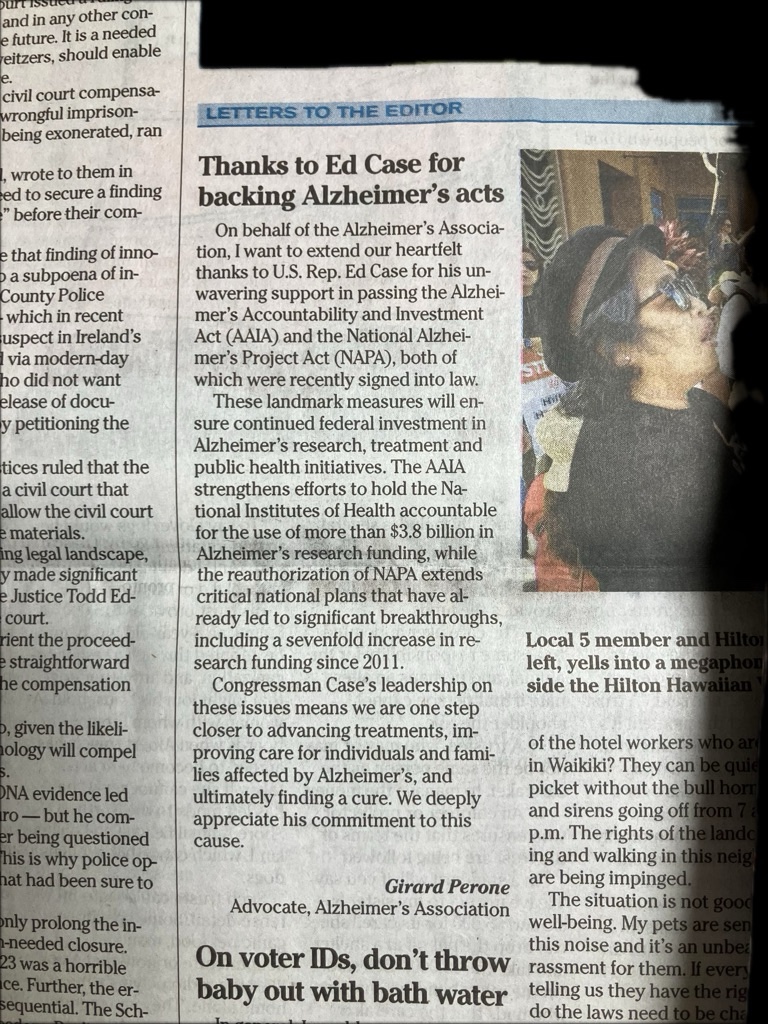
Thanks to Ed Case for backing Alzheimer’s acts
A letter thanking Representative Ed Case for supporting federal Alzheimer’s legislation and sustained research and care efforts.
Published October 15, 2024.
Titles, dates & bill numbers
Showing 40 of 40 items.
Scroll within the table for more. Select a title for its summary, or open the document directly. Dated work runs oldest to newest, followed by undated work and reference resources. Newspaper letters are under Articles; briefings, illustrations, fiction and reference resources are under Other.
My Alzheimer’s advocacy begins with people I love—and with the families trying to find their way through a disease that changes ordinary life. Writing gives me a way to carry those experiences into public conversations about earlier answers, better support and care that reaches people when they need it.
These pages follow that work from personal testimony to financial analysis, policy proposals and practical reports. My background in engineering and management leads me to ask what a proposal will cost, how it will work and how we will know whether families are better served. Behind every calculation is a person whose life is larger than a diagnosis.
Oldest to newest. Testimony is dated by its hearing; reports by their stated edition or revision. Month-only dates appear at the end of that month. Distinct statements for later hearings remain; repeat copies and superseded working versions are omitted. These are historical documents, with the facts, proposals and affiliations stated at the time—not a claim that every proposal became law or every prepared briefing was delivered.
Newspaper letter
A letter thanking Representative Ed Case for supporting federal Alzheimer’s legislation and sustained research and care efforts.
Published October 15, 2024.
Legislative testimony
A personal appeal for earlier detection, drawing on the experiences of Gladys and Rich.
Hearing date. Preserved as submitted; figures and proposals reflect the original statement. The same statement also appears in the February 7 HB700 packet; it is listed once here.
Legislative testimony
A longer statement connecting early assessment with the fear, exhaustion and decisions faced by families.
Hearing date. Preserved as submitted; figures and proposals reflect the original statement.
Article
An advocacy article celebrating early detection, dementia training and the work of Hawaiʻi families and volunteers.
Date comes from the supplied filename; publication is unverified. Personal-author edition: the original “on behalf of” attribution has been omitted. Legislative and medical statements are preserved as historical draft text, not updated guidance.
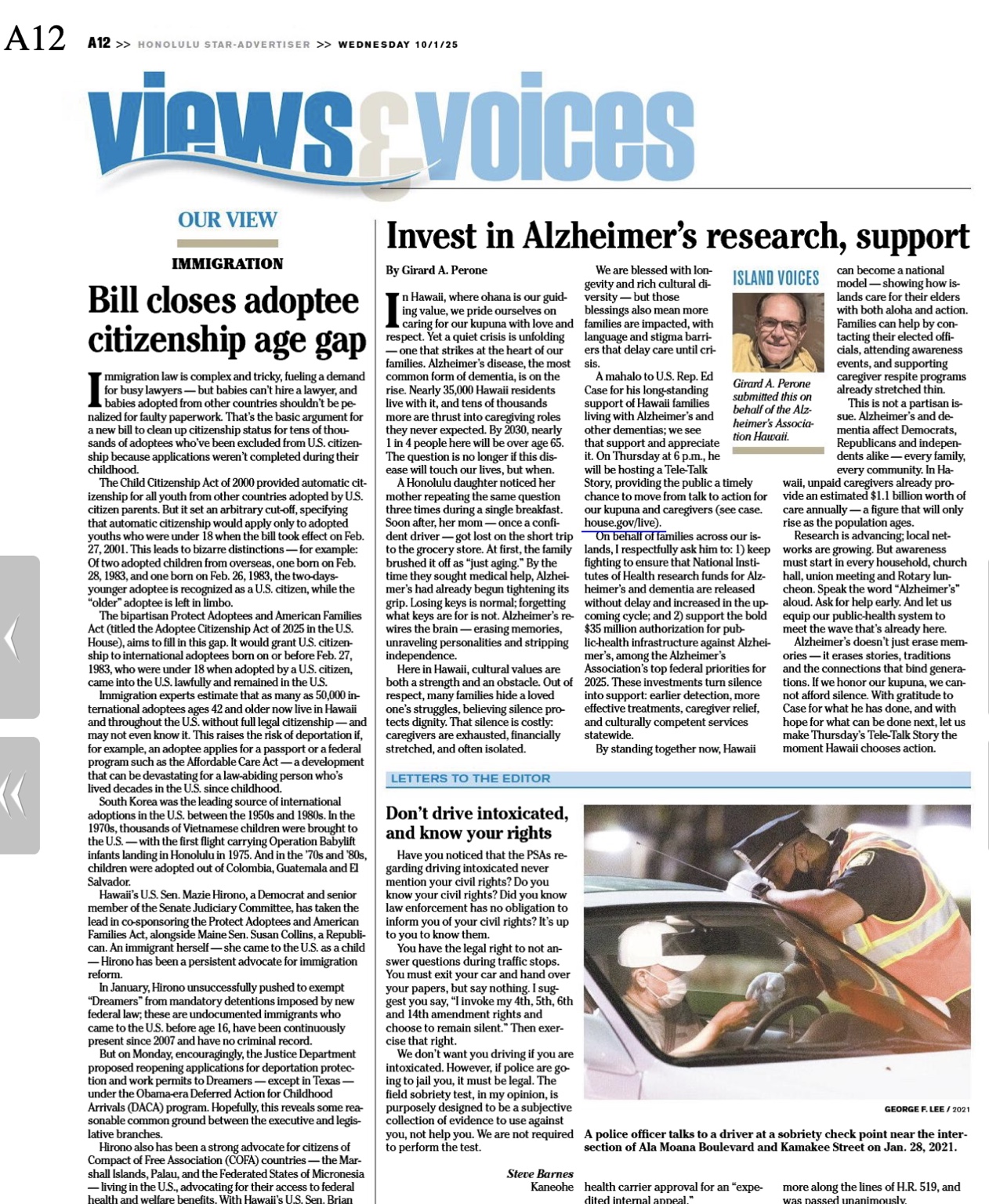
Newspaper article
An Island Voices appeal for investment in research and stronger support for the families living with dementia.
Honolulu Star-Advertiser, October 1, 2025, page A12. By Girard A. Perone.
Newspaper article
An Island Voices column connecting Hawaiʻi’s legislative efforts with developments in earlier detection.
Honolulu Star-Advertiser, December 7, 2025, page E1. The clipping shows the opening portion. Jerry’s complete author-supplied write-up appears below; it is not a transcription of the newspaper’s edited continuation. Historical wording and the original author bio are preserved.
By Girard “Jerry” Perone
Author’s original write-up accompanying the December 7, 2025 newspaper article. Preserved as historical writing; medical and legislative descriptions have not been updated.
Sometimes history doesn’t announce itself with fanfare or fireworks. It slips quietly into the world — in the form of a blood test, a needle, or a law passed in the final minutes of a long night at the Capitol. Yet these small moments can change the future of every family in Hawaiʻi. In the last hour of this year’s legislative session, four Alzheimer’s bills crossed the finish line like a miracle at the buzzer. The most transformative makes it mandatory that every Hawaiʻi resident age 65 and older receive a cognitive test during their annual Medicare wellness visit. For the first time, early detection is not just encouraged — it’s guaranteed by law. That victory was barely inked into the record when science added two astonishing new chapters to the story. The U.S. Food and Drug Administration has just approved a simple blood test that can detect Alzheimer’s years before memory loss begins. No brain scan. No invasive procedure. Just a vial of blood — a single act that can reveal the earliest whisper of disease and give families precious time to act. Days later came the second breakthrough: a subcutaneous auto-injector version of Leqembi (lecanemab) — the first Alzheimer’s medication proven to slow cognitive decline. Once confined to hospital infusion chairs, this therapy can now be administered safely at home. Imagine: instead of an exhausting trip to a medical center, a loved one sits peacefully at the kitchen table while a caregiver helps them receive the treatment that could preserve their sense of self. For Hawaiʻi, these discoveries are not abstractions. They are lifelines stretched across oceans and generations. On the neighbor islands, where memory clinics are few and inter-island travel can be costly and isolating, the ability to diagnose early and treat at home could mean the difference between hope and heartbreak. Our kūpuna deserve not distance, but dignity. Yet the promise of these tools depends on what we do next. If access is limited to those who can afford it, then we have merely traded one form of inequality for another. We must insist that insurance coverage, caregiver training, and telehealth networks reach every island and every community — from Kalihi to Kaunakakai. Hawaiʻi’s strength has always been its sense of ʻohana; now it must become the framework of our health system. We stand at a defining moment. The science is ready. The technology is here. The law has opened the door. What remains is the moral choice to walk through it — together. If Hawaiʻi acts now, our islands can become the world’s model for how compassion, culture, and innovation can defeat despair. A place where Alzheimer’s is discovered early, treated at home, and met with the love of family rather than the loneliness of distance. Talk to your doctor. Ask about the new blood tests and cognitive screenings. Encourage your legislators to make these treatments accessible to all. Because the future of Alzheimer’s care will not be written in laboratories or legislatures alone — it will be written around the kitchen tables of Hawaiʻi. And if we do this right, the world will learn from us how a small chain of islands chose to remember what truly matters.
Girard “Jerry” Perone is an Alzheimer’s Association Hawaiʻi Ambassador and Community Advocate.
Report
A comparison of dementia care pathways and modeled long-term care costs in Hawaiʻi and the mainland, with island-level benchmarks and international context.
Prepared January 23, 2026 for Girard Perone. Historical estimates are illustrative models, not current quotes or individual medical or financial advice.
Legislative testimony
A call for a clear pathway from a family’s first concern to diagnosis, care navigation and support across the islands.
Hearing date. Preserved as submitted; figures and proposals reflect the original statement.
Legislative testimony
Testimony and a household-cost exhibit explaining why coordinated dementia care matters to both families and public budgets.
Hearing date. Preserved as submitted; figures and proposals reflect the original statement.
Legislative testimony
A proposal for practical dementia training and recognition that helps businesses respond with patience and understanding.
Hearing date. Preserved as submitted; figures and proposals reflect the original statement.
Report
Plain-language explanations of the terms and formulas behind the financial case for coordinated dementia care.
Report edition shown; information and assumptions reflect that edition.
Report
A guide to the cost, outcomes, risk and accountability questions faced by legislative budget committees.
Report edition shown; information and assumptions reflect that edition.
Report
A financial briefing for House Finance and Senate Ways and Means, including appropriation guardrails, oversight and risk controls.
Report edition shown; information and assumptions reflect that edition.
Advocacy report templates
Six humorous, Sicilian-flavored templates for congressional and advocacy meeting reports in the Alzheimer’s Impact Movement (AIM) system, with reusable signature lines and guidance for adapting them.
Legislative testimony
A statement bringing together access to care, an appropriation request, break-even analysis and measurable accountability.
Hearing date. Preserved as submitted; figures and proposals reflect the original statement.
Legislative testimony
A Finance Committee statement on dementia-capable customer service, caregiver confidence and participation in community life.
Hearing date. Preserved as submitted; figures and proposals reflect the original statement. A repeated copy appears in the April 7 HB1976 packet; it is not a separate HB1976 statement.
Legislative testimony
Testimony with a financial addendum and exhibits arguing for timely funding and implementation.
Hearing date. Preserved as submitted; figures and proposals reflect the original statement.
Report
A modeling report exploring the burden of delay and a proposed 180-day implementation pathway for coordinated dementia care.
Models and implementation assumptions are preserved as historical analysis.
Report
An April 2026 planning snapshot examining a proposed implementation approach, funding allocation and measurable outcomes.
Report edition shown; information and assumptions reflect that edition.
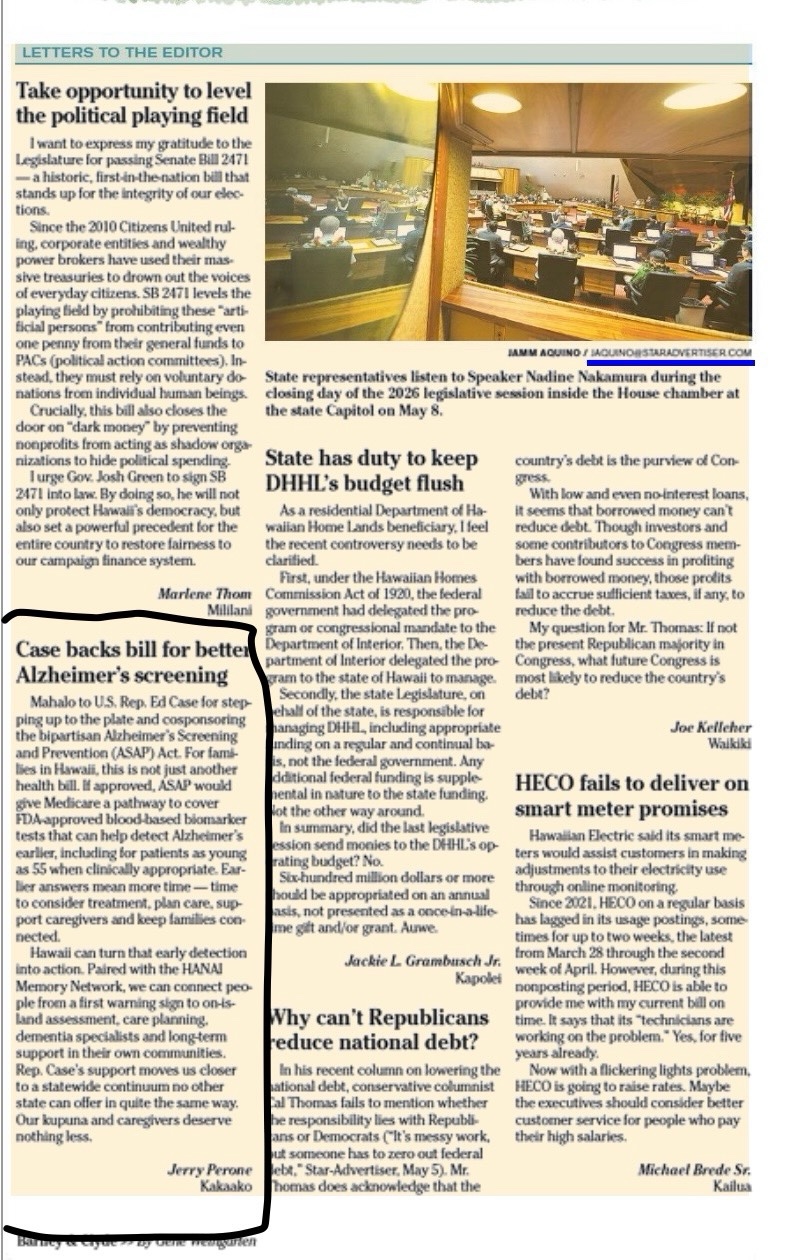
Newspaper letter
A letter connecting support for earlier detection with care planning, caregiver support and the HĀNAI Memory Network.
Report
An analysis of how earlier detection, workforce preparation and care coordination could work together, with financial scenarios.
Report edition shown; information and assumptions reflect that edition.
Policy report
A standalone policy and implementation report connecting earlier detection, workforce training, navigation and family support. Includes the source’s prevalence and genetics research appendices.
June 1 source edition; the original report cover is dated May 30, 2026. Repackaged for separate reading with fresh pagination. The later September 21 combined edition remains available below.
Illustrated fiction
A fictional family story showing how a coordinated dementia-care system could feel in everyday life. Published as a standalone narrative with its own cover and source notes.
From the June 1 source edition. Characters and imagined future outcomes are fictional. Cover photograph retained from the source and credited to the National Park Service.
Report illustrations
A two-part collection of charts and diagrams illustrating the relationships among care coordination, workforce capacity, costs and accountability.
Policy overview
A visual chronology linking awareness, early detection, workforce training, first responders and care navigation.
2026 policy snapshot.
Report
A statewide policy report on caregiving, service capacity and future pressures, distinguishing published benchmarks from planning estimates.
Report edition shown; information and assumptions reflect that edition.
Report
An examination of dementia care in Guam, Saipan and Tinian, including access across islands and gaps in available evidence.
August 2026 edition; exact publication day is not stated. Placement within August is approximate.
Report
A report on population change, caregiving, clinical capacity and policy options in American Samoa, separating evidence from modeled scenarios.
August 2026 edition; exact publication day is not stated. Placement within August is approximate.
Report
A stage-based guide to technology for people living with cognitive decline and the caregivers who support them.
Report edition shown; information and assumptions reflect that edition.
Report
A human and policy portrait of dementia in Hawaiʻi, connecting the everyday experience of caregiving with public services and policy choices.
Report edition shown; information and assumptions reflect that edition.
Report
A study of a potential service helping families choose, set up and continue using supportive technology. Proposed prices and business outcomes are planning assumptions.
Report edition shown; information and assumptions reflect that edition.
Briefing materials
Materials prepared for discussion with Alan Muneoka in Representative Ed Case’s office, connecting detection, provider training and care delivery.
Dated preparation materials; no legislative submission or outcome is implied.
Briefing materials
A staff brief asking how an abnormal test result can lead to timely clinical evaluation and a workable care plan.
Prepared for September 14, 2026. The companion handout poses questions for the September 15 hearing.
Report
A research review explaining the experimental nanoparticle approach, what the animal studies tested and what remains unproven in people.
Report edition shown; information and assumptions reflect that edition.
Report
A plain-language guide to four blood tests, interpretation, regulatory terminology and questions about access and follow-up care.
Version 3, September 29, 2026. Replaces the Version 2 feature in this collection.
Report
Research delays have a human cost. This report examines disruptions to NIH Alzheimer’s and dementia grants during the Trump administration, estimates the funding affected and explains what the records cannot tell us.
Report dated October 2, 2026. Its approximately $25 million unpaid-funds estimate comes from a grant tracker; it is not an NIH-confirmed current balance. Delayed, ended and restored grants are distinguished, and overlapping figures are not added together.
The Hawaiʻi state strategic plan and outside organizations provide context for this work. They are credited to their publishers and are not presented as my authored reports.
Official reference copy; Senate pages updated December 2025 and House pages January 2026. Historical contacts may have changed.
Published by the Alzheimer’s Association. The 2025 filename does not change the publication’s 2024 edition date.
This collection includes the materials located and reviewed for this edition. It is not a verified record of every submission or appearance. Research reports are for education and policy discussion, not individual medical advice.