Until about ten years ago, I was like just about everybody else.
I believed things.
Not insane things. I was not in a basement with a tinfoil hat trying to decode secret messages from the Weather Channel. I mean regular things. Civilized things. The kind of things normal people believe so society can keep pretending it has a quality-control department.
For example, I believed the back cover of books.
If I picked up a business book and it said, "Dr. So-and-So is one of America's leading experts on leadership, innovation, growth, transformation, excellence, disruption, and whatever other words were expensive that year," I believed it.
If the back cover said, "This book changed my life," I assumed the book had actually come into contact with that person's life.
I thought there was a system. I thought somebody checked. I thought before you could call yourself one of America's leading experts, America had to vote. Or at least there had to be a committee. Maybe a Department of Experts somewhere in Washington, D.C., with a seal on the wall and a bored man named Carl saying, "I'm sorry, sir. You are currently ranked forty-seventh. You may use regional thought leader until your next review."
But there is no Carl.
There is no department.
There is only marketing.
I found this out after I left IBM and decided to write a book called Entrepreneur Boot Camp.
That title tells you exactly where my head was. I was not just writing a business book. I was writing a business book with push-ups.
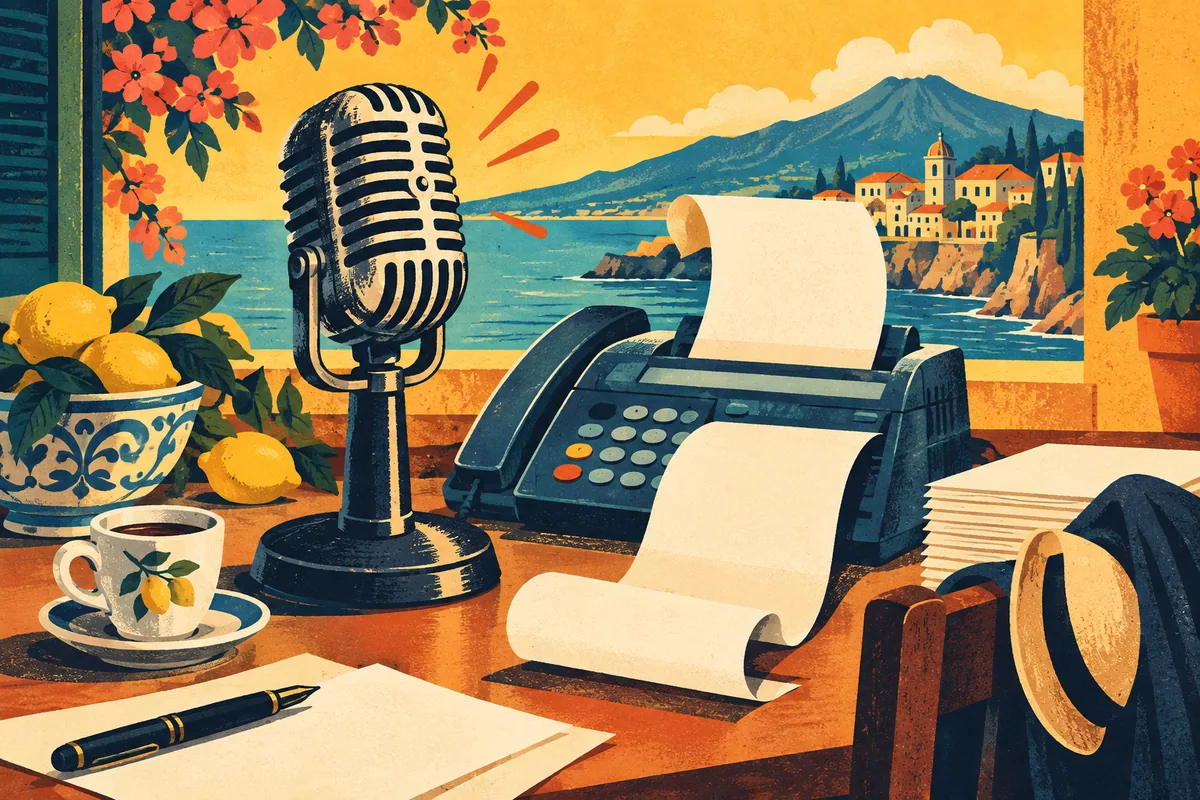
For a while, I even had a radio show by the same name on WBZS Business Radio, which was a Viacom channel at the time. The studio was in Alexandria, Virginia, and I will tell you, there is something about sitting in a radio studio that makes you feel official.
You put on headphones, you sit in front of a microphone, a little red light says ON AIR, and suddenly you are Walter Cronkite with parking validation.
So I am writing the book, doing the radio show, building this whole new identity. I am no longer just a guy who left IBM. I am an author. A consultant. A radio host. A small business expert. A man with a microphone and a laminated visitor badge.
And then the publisher gets interested in my book.
Now, when a publisher gets interested in your book, you immediately become impossible to live with.
You start using phrases like, "my publisher." As in, "I'd love to come to dinner, but I have a call with my publisher." The call is nine minutes and mostly about commas, but still: my publisher.
One day the publishing representative meets with me and says, "We need endorsements for the back cover."
And I say, "Great. How do we do that?"
In my innocent little mind, I picture a very noble process. We send the manuscript to distinguished people. They read it carefully. They sit in leather chairs by fireplaces. Maybe there is a pipe involved. They underline passages. They think deeply. Then, after much reflection, they write, "This is an important contribution to the literature of entrepreneurship."
That is what I thought happened.
What actually happened was different.
The publishing representative says, "Our marketing people will write about fifty comments they would like to see on the back cover. Then we fax that list to people we know - celebrities, authors, people who have written books for us - and they check off one of the comments, sign it, and fax it back."
I said, "Without reading the book?"
He looked at me like I had just asked if the Easter Bunny has a 401(k).
He said, "Yeah."
And that was strike one.
Because up until then, I thought endorsements were endorsements. I thought when a famous person said, "This book changed my life," it meant that somewhere, at some point, the book and the life had met.
I did not realize it might mean, "This sentence was option C on a fax."
I imagined some celebrity on a boat, eating a sandwich, yelling to an assistant, "Linda, did I love this book?" And Linda yelling back, "No, you found it essential."
So that was the first crack in the wall. But I did not give up on humanity right away. I am not unreasonable. I said to myself, "Okay, book endorsements are bullshit. That does not mean everything is bullshit."
That was my mistake.
Because once the universe sees that you have noticed one piece of bullshit, it immediately introduces you to the next piece.
And before I even get to the next official strike, I have to admit something: the funniest and most painful evidence was sitting right in front of me. Literally. It had headphones on.
It was my own radio show.
Remember, I was very proud of having a radio show. Entrepreneur Boot Camp on WBZS Business Radio. A Viacom channel. That sounded impressive. It sounded like someone had discovered me. It sounded like a producer somewhere had said, "America needs this voice. This man must be brought to the small business community immediately."
America had not requested this voice.
Accounts receivable had approved this voice.
The way I got the show was that I paid ten thousand dollars for a block of weeks.
Ten thousand dollars.
That is the moment, later, when I realized what had actually happened. I had paid ten thousand dollars to make it appear that Viacom had hired me - or at least selected me - as a small business expert.
Think about how elegant that is as bullshit. I paid money so it would look like someone else thought I was worth money.
There was no talent scout. There was no executive saying, "Get me the Entrepreneur Boot Camp guy." There was a rate card.
My audition was a check clearing.
That is not broadcasting. That is karaoke for capitalism.
I bought time. I bought access to a microphone. I bought the right to sit in a studio, speak in a serious voice, and then later tell people, "As I said recently on my radio show..."
That is a beautiful phrase: "as I said recently on my radio show." It sounds like the world came to you. It does not sound like you came to the world with a checkbook.
And the station had that business-radio aura all week long. Business experts. Business authorities. Business people talking about leadership, markets, entrepreneurship, investments, risk, growth, strategy, and whatever else you could say into a microphone while sounding like you owned at least two suits.
Now, to be fair, some of those people may have known exactly what they were talking about. I am sure some did. But the point is, the microphone was not proof. The microphone was available for purchase.
And that was when the story stopped being about other people. Because I was not just discovering manufactured credibility. I had manufactured a little of my own.
I had not been hired by Viacom. I had hired the appearance of being hired by Viacom.
That is not just bullshit. That is bullshit with an invoice.
So now, with that humbling little receipt in my pocket, I notice another object in the radio studio that looks very official.
It is a book called Yearbook of Experts, Authorities, and Spokespersons.
Now that is a title. Experts. Authorities. Spokespersons. Those are three words that all say, "You may trust me during a crisis."
I start flipping through it and I see names I recognize. Celebrities. Public figures. Serious-looking people with serious-looking descriptions. And my first reaction is not, "What a valuable public resource." My first reaction is, "Why am I not in here?"
So I decide I am going to get listed as an expert in project management and risk management.
Again, I assume there is a process. I think I will need documentation. Credentials. Proof. Maybe someone will ask me tough questions. "Can you define scope creep without crying?"
So I put together materials. Articles. Things I had written. Things I had done. Evidence that I was, in fact, a serious person. I find out the publisher, Mitch Davis, is in Washington, D.C., where I lived, so I set up a meeting.
I go downtown with my folder, ready to make my case for why I deserve to be listed as an expert.
We exchange pleasantries. Where are you from? What do you do? How long have you been in D.C.? Normal civilized conversation, the kind that makes you believe institutions are still functioning.
Finally I say, "Mitch, I would really like to be listed in your book as an expert in project management and risk management. What documentation do you need from me?"
And he says, "Oh, it is not that complicated."
That is rarely a good sentence.
When someone says, "It is not that complicated," what they usually mean is, "You are about to lose respect for the entire process."
He says, "Do you want a quarter page, half page, or whole page?"
And I am sitting there with my folder of evidence. My proof. My documentation. My sincere belief in civilization.
And I realize he is not asking whether I am an expert.
He is asking what size ad I want to buy.
That was strike two.
Because this was not, as I understood it, a yearbook of experts. It was a yearbook of people with checks. Maybe some of them were experts. I am sure some were. But the process did not appear to be, "Let us evaluate your expertise." It appeared to be, "Let us evaluate your payment method."
I remember leaving that meeting with the feeling you get when you find out how hot dogs are made. You are not necessarily surprised. But you are changed.
So now I have strike one: endorsements can be faxed. I have the radio-show confession: credibility can be rented by the week. I have strike two: expertise can be bought by the page.
And at this point I am thinking, "If one more thing turns out to be bullshit, I am going to have to declare the entire world bullshit."
I did not want to. I was trying to be fair. But there are rules.
Three strikes.
And let me tell you, the pitcher did not waste any time.
Because at this point I am trying to become a consultant. I had left IBM. I wanted to consult in project management and risk management.
That sounds respectable, does it not? Consultant.
It is a beautiful word. Nobody knows exactly what it means, but everybody agrees it sounds expensive.
A consultant is basically someone who walks into your company, asks where the conference room is, and then says the same thing your employees have been saying for six years - but in a PowerPoint deck.
And I wanted to be one.
The only problem was getting money to come in the door. This is a common obstacle in consulting. You have the expertise. You have the business cards. You have the confidence. What you do not have is anyone willing to pay you.
So I start meeting other consultants. People who are already doing it. People who understand the game.
And they tell me, "You really have to start with training classes."
Training classes. That made sense. Teach project management. Teach risk management. Build credibility. Meet clients. Get consulting work.
Again, I was still trying. I still had a little candle of innocence burning inside me.
And then I got to know some of these people.
And they started telling me how the business actually worked.
They said, "Well, you do not really have to know that much about project management."
I said, "I am sorry, what?"
They said, "Some of these guys have never even been project managers."
I said, "How are they teaching project management?"
And the answer was basically: confidence.
Confidence and a binder.
They told me you just read enough before the class to stay one day ahead of the students.
That is it.
You do not need to know the subject. You need to know more than they know by 8:30 tomorrow morning.
And if somebody asks a question you do not know, there are techniques.
You say, "That is a great question. Let us put that in the parking lot."
The parking lot is where questions go to die.
Every training room has one. It is usually a flip chart with sticky notes on it. By the end of the class, the parking lot is full of unanswered questions, and everyone quietly agrees not to make eye contact with it.
Or you say, "Let us open that up to the group."
That is consultant language for, "I have no idea."
You say, "How would others handle that in your organization?" Now suddenly the students are teaching the class, and you are nodding like a genius.
"Excellent point, Bill."
Bill has just saved your life.
And these trainers had a word for it. They did not call it training. They did not call it education.
They called it edu-tainment.
Which is a wonderful word, because it tells you right up front that learning is optional.
Strike three.
So now I had the evidence.
Endorsements could be faxed. A radio show could be purchased. Expert status could be bought by the page. Training could be a man with a binder trying to stay one chapter ahead of the room.
And the worst part was, I could not even pretend I was innocent.
Because I had bought the radio show.
I had used the microphone.
I had said, "Welcome to Entrepreneur Boot Camp," in a voice that suggested I had been chosen by the broadcasting gods, when in reality I had been chosen by accounts receivable.
I was not just discovering the bullshit economy.
I had a booth at the trade show.
And that is when I realized something important.
I used to think credibility was earned. Then I learned it can also be rented, faxed, purchased, packaged, and sold.
The world is not divided into experts and non-experts. It is divided into people who know how credibility is manufactured and people who are still reading the back cover of the book.
I used to read "This book changed my life" and think, "Wow, I should buy that." Now I think, "Did you read it, or did Linda check option C?"
I used to hear someone introduced as a nationally recognized authority and think, "This person must really know the subject." Now I think, "Quarter page or half page?"
I used to hear someone on business radio and think, "This person must be important." Now I think, "Was he invited, or did his check clear?"
And after all of that, the question for me was no longer, "Is the world bullshit?" That case was closed.
The question was, "How do I profit from knowing the world is bullshit without becoming one more guy on the radio pretending he was invited?"
Honestly, I am still working on that part.
But I did learn this: in a world full of manufactured credibility, the rarest product is not information. The rarest product is judgment.
And I wish I had had a little more judgment before I spent ten thousand dollars to appear as if Viacom had hired me.
Because they did not hire me.
I hired the illusion that they had.