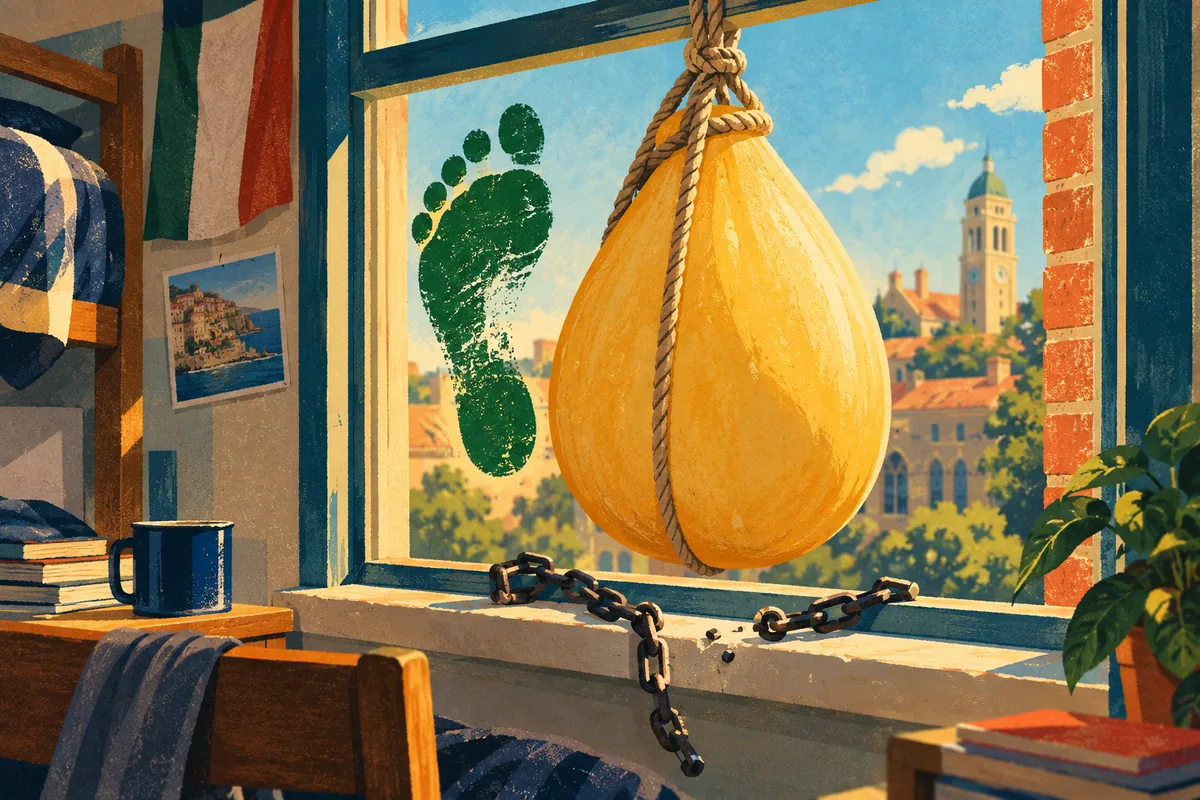
The first criminal organization I ever helped establish had two members, no budget, one enormous provolone - and a logo: A green foot. Before I go any further, this happened at the University of Dayton a very long time ago. I assume the statute of limitations has expired. If it hasn't, my name is Phil Guzzardo. Phil was actually my college roommate. He was Phil Guzzardo. I was Jerry Perone.
Together, we sounded less like college students and more like a law firm representing organized cheese. Phil and I weren't merely Italian. We were college-aged Italian paisans - which meant we had enormous appetites, tremendous confidence, great respect for our heritage, and absolutely no adult supervision. We celebrated our Italian culture right there in our dormitory room. And we had evidence hanging in the window.
It was an enormous provolone cheese. Not a package of provolone slices. Not something you put politely between two pieces of bread. This was the whole provolone - a magnificent, full-sized Italian monument hanging from a rope in our dormitory window, with a large knife stuck into it. Our room looked like an Italian delicatessen that had been placed in the Witness Protection Program.
Every night before bed, Phil and I performed the same sacred ritual. We would cut a large chunk from the provolone, pour ourselves a little wine, raise our glasses and make a toast. Other students brushed their teeth. Looking back, it had the atmosphere of a scene from The Godfather. But this was a Catholic university, so we considered it a religious observance.
The provolone was our evening snack, our connection to our families and our emergency food supply. If the Russians had invaded Dayton, Ohio, Phil and I could have survived for at least six weeks. Although after the first three days, we would have needed crackers. Now, getting from our dormitory to class required transportation. There was a very convenient little access road that went around the back of the men's dormitory.
You could drive around, park behind the dorm, walk down the hill and be at your first class in minutes. It was perfect. It probably saved us five minutes every morning. At nineteen years old, five extra minutes of sleep is more important than honesty, morality or your permanent academic record. This system worked beautifully for several months.
Then campus security put up a chain across the road. To campus security, this was a routine traffic-control measure. To Phil and me, it was the Berlin Wall. Only this Berlin Wall was blocking two Italian boys from getting to an eight-o'clock class. Most reasonable students would have found another parking space. But reasonable students did not sleep beneath a hanging provolone.
Phil and I studied the chain. We discussed the chain. We became emotionally involved with the chain. Why was it there? Who had authorized it? Had there been hearings? Had the Italian-American community been consulted? Finally, we reached the only logical conclusion: The chain had to go. We could have written a letter to the university administration, but this was before email - and stamps cost money.
So, under the cover of darkness, Phil and I launched our first Green Foot caper. Why a green foot? I have absolutely no idea. There was no committee. No focus group. No marketing research. One of us apparently suggested a green foot, and the other one apparently said, "Perfect." That was the entire branding strategy. Armed with a pair of cutters and all the tactical sophistication that comes from provolone and wine, we slipped behind the dormitory.
We cut the chain. Then, at both ends of the fallen chain, we left the symbol of the Green Foot. That was our signature. It was not anonymous enough to be safe. It was just anonymous enough to be exciting. The next morning, we drove to the back of the dormitory expecting to celebrate our victory. The chain was back.
Campus security had replaced it. They hadn't even acknowledged our artwork. No note. No thank-you. No constructive criticism. They simply put up another chain. Phil and I were offended. This was no longer a disagreement about parking. This was now correspondence. That night, the Green Foot struck again. We cut down the second chain and left another green-foot symbol.
The following morning, campus security put the chain back up again. These people were stubborn. Worse yet, they apparently had an unlimited chain budget. By this time, people around campus were beginning to talk about the Green Foot. We would hear conversations in the cafeteria. "Did you hear? The Green Foot struck again!" Phil and I would sit there eating lunch, trying to look completely innocent.
Phil would whisper, "Jerry, they're talking about us." I'd say, "Don't look at them. Just chew naturally." Have you ever tried to chew naturally? The minute somebody tells you to chew naturally, you forget how your mouth works. Suddenly, you're sitting there with meatloaf hanging out of your face, looking exactly like a man who cuts down chains at night.
The Green Foot began taking on a life of his own. Whenever anything strange happened around campus, someone blamed the Green Foot. Some of those capers may have been ours. Some may not have been ours. We accepted emotional credit for all of them. The Green Foot had become part outlaw, part urban legend and part unidentified podiatric condition.
But security replaced the chain yet again. Now Phil and I realized we had been approaching the problem incorrectly. Cutting the chain was merely a temporary solution. As long as campus security still possessed the chain, they could continue putting it back up. We needed to stop treating the symptom and eliminate the root cause. The chain could not simply be cut.
The chain had to disappear. Years later, I would build an entire career in project management. Looking back, this was probably my first strategic project plan. We had a clearly defined objective: remove the chain. We had a schedule: tonight. We had assigned resources: Phil, Jerry and one automobile. We had a communications plan: green foot. We had no risk-management plan whatsoever.
That night, we returned under the cover of darkness. One of us operated the cutters. The other performed the essential executive-management function of whispering: "Hurry up!" Finally, the chain came down. We began dragging it toward the bushes so no one would see us. Here is something you may not know about heavy chains: They have only one volume setting.
CLANK! CLANK! CLANK! Every link hitting the pavement seemed to be announcing: THE CRIMINALS ARE OVER HERE! Phil whispered, "Keep it quiet!" I don't know whether he was talking to me or to the chain. Either way, the chain refused to cooperate. CLANK! CLANK! CLANK! We eventually dragged it into the bushes, rolled it up and wrestled it into the car.
If you have never tried to roll up a heavy chain in complete darkness, it is like wrestling an iron snake that knows your GPA. We placed it in the car and arranged for it to disappear someplace where campus security would never find it. But before leaving, we had one final responsibility. The Green Foot needed to send a message.
And this time, a simple footprint was not enough. This caper required poetry. We left behind the Green Foot symbol and the following verse:
Two and two is four.
Four and six is ten.
If you put the chain back up,
the Green Foot strikes again.
I want you to appreciate what had happened here. Phil and I had progressed from vandalism to literature. And remember, I was an engineering student. That poem was mathematically flawless. Grammatically questionable - but mathematically flawless. It may have been the first criminal threat in University of Dayton history to include validated arithmetic. The following morning, we drove behind the dormitory.
There was no chain. The next day - still no chain. The chain never appeared again. The Green Foot had won. Or campus security had simply run out of chains. Victory does not require a detailed explanation. But now the Green Foot was becoming famous - and fame is very dangerous when you are running a two-man secret organization from a dormitory room containing wine, cutting tools and a suspended dairy product.
People were talking. Campus security was looking for suspects. Suddenly, everything green in our room looked like forensic evidence. Phil and I conducted a mature and objective risk assessment. It took approximately eleven seconds. We decided it was time to retire the Green Foot. We put the Green Foot away, put our white socks back on and officially buried him forever.
This decision had nothing to do with remorse or moral development. It was based entirely on the growing possibility that we could be caught. Because getting expelled from college would have been bad. Explaining to our Italian parents that we had been expelled over a parking shortcut would have been much worse. "What do you mean, you lost your education over a chain?"
"But Mom, we had a symbol." "A symbol?" "A green foot." At that point, campus security would have been the least of our problems. Some college roommates build their friendship through long, heartfelt conversations. Phil and I bonded over provolone, wine and a shared felony. And years later, after a career spent recovering troubled projects, I can finally give the Green Foot operation a professional evaluation:
The objective was clear. The branding was memorable. Execution was decisive. Stakeholder engagement was catastrophic. Risk management was nonexistent. Overall assessment: Highly successful. Do not repeat. Officially, the Green Foot was buried that night. But a symbol like that never completely disappears. Even today, whenever I see a pointless obstacle, an unnecessary chain - or a particularly impressive piece of provolone - somewhere deep inside me, one little green toe begins to twitch.
Because two and two is four. Four and six is ten. And if you put that chain back up... Well, by now, you know what happens then.