Before I begin, I want to say I love animals. I also love my mother. This story is about the day these two loves failed to coordinate.
My mother was Theresa, but everybody called her Tree. Not because she was leafy and serene. Because Tree did not bend. Tree gave shade, yes, but if you walked into her, that was on you. In our family the hierarchy was God, Tree, and whichever aunt had the serving spoon.
Mother's Day, 1989. My mother's family had a rare gift: they carried weight, and they carried it for a very long time. This is not a fat joke; it is a structural engineering report. My mother lived to 83 and was around 320 pounds. Aunt Marion, her sister, made it to 92 and around 425. By then, the doctors had stopped predicting and started taking notes.
My father was about 250, and Uncle Nicky was about 225, although Uncle Nicky's weight included whatever he was legally or illegally carrying. He had done time for armed robbery. When Uncle Nicky said, "Pass the rolls," you passed them open-palmed, like you were approaching a customs agent.
I was about 250. My wife Carol was a tiny 110, which in my family made her not a person but a breadstick. Our son Adam was eight, still too young to understand that in a Sicilian family food is not nutrition. Food is foreign policy.
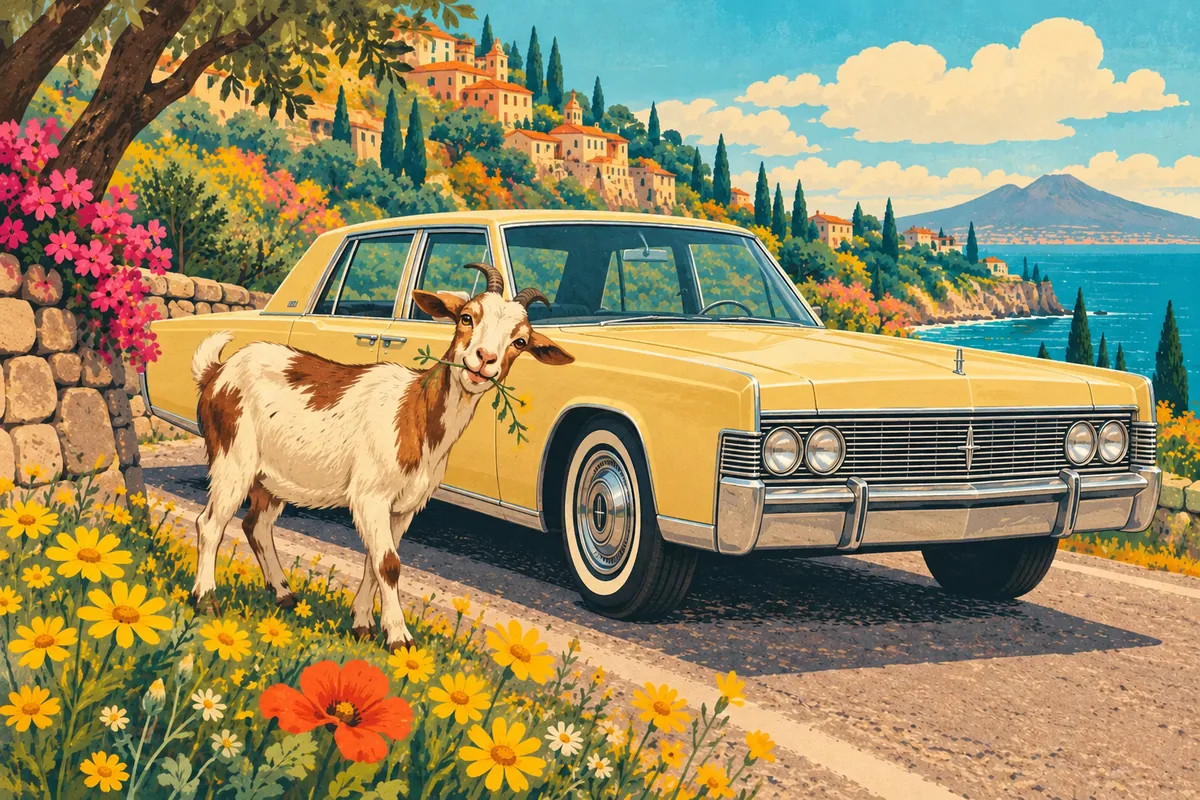
My father owned the largest yellow Lincoln I had ever seen. He called it "his boat." It was yellow like his tow trucks, because our whole family was colorblind and yellow was one of the few colors we trusted. If the car had been blue, we would have thought it was evening.
This Lincoln had rear doors that opened backward. When you opened all four doors, it looked less like a car and more like the county fair ride where you win a stuffed animal and a back injury. You could board that thing by zone.
So we poured into it. Tree drove, because my father fell asleep in cars the way other people blink. He could fall asleep on a ride to the mailbox. Carol sat in the front middle, between my parents, which is a marriage test I do not recommend. In the back was Aunt Marion, Uncle Nicky, me, and Adam tucked into whatever air remained.
We headed through the Pine Barrens of South Jersey to some restaurant that my mother had previously scouted. On these roads even the trees look like they do not want to testify.
Then I saw it.
A goat.
Not a little Disney goat. A real goat. A Pine Barrens goat. It came from the left like it had somewhere to be and no respect for Mother's Day reservations. It was not running. It was not confused. It had the confidence of a goat whose family had never met Sicilians.
I saw it first because I was the only adult still awake and not fighting for oxygen. Aunt Marion saw it. Carol saw it. Adam saw it. The goat saw us. Everybody saw everybody except, possibly, Tree.
Now, I am no Alan Turing, but I know the math. If a goat is moving at goat speed, at a goat angle, with full goat commitment, and a yellow Lincoln containing almost 2,000 pounds of fresh family is moving at brunch speed, eventually the universe asks for a signature.
Tree, let me be clear, had perfect vision. She could see a coupon expiring three towns away. The eye doctors called her an emmetrope. I looked that up later because when your mother hits livestock you start researching.
An emmetrope is an individual with normal, "perfect" vision who requires no corrective lenses.
We all watched. Nobody spoke right away because in a Sicilian family you do not correct your mother too early. You collect evidence. You wait until the disaster is no longer preventable and then you yell as a group.
Finally we all screamed, "Tree! Goat! Left!"
Boom.
My mother hit the goat.
She did not clip the goat. She did not introduce herself to the goat. She administered the Lincoln.
And now we were stopped in the middle of the road, with one goat somewhere under the car, one eight-year-old boy discovering mortality, and one Sicilian mother facing a terrible obstacle between her and brunch.
A normal person would get out.
Not Tree.
Tree believed in EOM: Economy of Motion. In her words: never move unless you have to. This was not laziness. This was a commandment. Moses came down with ten. Tree had eleven.
So from the driver's seat she created a solution.
Reverse fast. Drive forward fast. Reverse fast. Drive forward fast.
The Lincoln became a carnival ride for people with outstanding medical risk. My father slept through it. Uncle Nicky opened one eye, probably to see if there were sirens, then went back to sleep. Aunt Marion sounded like an accordion being stepped on. Carol was praying quietly, which in my family made her the outsider. I was praying in Italian: loud, with hand gestures.
Adam yelled, "What is happening?"
I said, "Everything is fine," which is what adults say when nothing is fine and there is a goat in the transmission.
After a few rounds of Tree's agricultural snowplow maneuver, the goat appeared in front of the car.
Now, I want credit for honesty here: the goat did not appear happy. But he was visible, and in my mother's system visible is progress.
At that exact spot there was a tall hedge. Behind it, a tiny stone house. The kind of house where you do not knock; you solve the riddle first.
Tree looked at me and said, "Jerry. Go."
That was the whole speech.
In Sicilian, "Jerry. Go" means: go to the house, apologize without admitting liability, find the goat people, protect the family name, and be back before the eggs get cold.
Why me? Because my father was asleep, Uncle Nicky had a complicated relationship with law enforcement, Adam was eight, and Aunt Marion would have required a municipal permit to deploy.
So I walked to the house. I was thinking Deliverance. I could hear banjo music, but honestly it might have been my blood pressure.
I knocked. The door opened. There stood a tiny old woman with an oxygen tank on wheels. She removed the nose tubes and looked at me like she had been expecting a goat-related interruption since breakfast.
I did not want to get too close. One spark and Mother's Day becomes a federal incident. I said nothing. I pointed.
She looked past me: yellow Lincoln, goat, family pressed against the windows like a deli counter of witnesses.
She put the oxygen back on. Closed the door.
No words.
I thought, maybe that is it. Maybe in the Pine Barrens, pointing is a full confession. Then the door flew open again and out came a young man, maybe nineteen or twenty,
carrying a shotgun. He was not angry. That was the upsetting part. He looked like this was a chore. Like his grandmother had said, "Take out the trash, change the laundry, conclude the goat."
He walked toward the hedge. I walked near him because I did not know the protocol. Do I shake his hand? Do I tip him? Do I say, "We are very sorry about your goat, but we are late for French toast"?
When we got to the hedge, I decided my involvement had reached its natural conclusion. I moved toward the Lincoln with the dignity of a man choosing not to be next.
The young man peered over the hedge. Raised the shotgun. Turned his hat around.
And yelled, "Pull!"
I looked around. Pull what? A rope? A permit? My last will and testament?
Then again: "Pull!" Bang.
And that was the end of the goat's participation in Mother's Day.
The young man lowered the gun and walked back to the house. No lecture. No invoice. No Yelp review. Just rural customer service: efficient, terrifying, and cash-only in spirit.
I jumped into the back seat and shouted, "Ma, step on it!"
Tree hit the gas. No questions. No "Is the goat okay?" No "Are we emotionally prepared to continue?" Just pedal down, yellow Lincoln moving, brunch still legally obtainable.
Adam started crying, "The goat is dead! The goat is dead!"
Nobody knew what to say, because he was right. Children ruin family denial by being accurate.
Then, from somewhere in that car, I heard a voice say, "So... are we still going to brunch?"
And of course we were.
We were Sicilian. In our family, tragedy did not cancel a meal. It gave you something to talk about during the meal.
I do not remember what we ate. I remember Adam looking at us like he had been kidnapped by relatives. I remember my father waking up later and asking, "Are we there yet?" and all of us thinking, you missed the whole war.
For years I thought this story was about the goat.
It is not.
It is about Tree.
My mother was not soft. She was not sentimental in the greeting-card way. She came from people who survived by keeping moving, or in her case, by moving only when absolutely necessary. Panic was waste. Explanation was waste. Brunch, however, was not waste.
Tree loved us in actions. She drove the boat. She carried the family. She handled the impossible thing in front of her, delegated the thing that required a doorbell, and kept going.
That is why I miss her.
Because when life throws a goat into the road - and life eventually throws everybody a goat - I still hear her voice.
"Jerry. Go."
And I know exactly what she means.
Check the left side. Keep moving. Do not embarrass the family. And whatever happens, make the brunch.